ID_455:ID2_913 :: Копия содержания
страницы:
ID_455:ID2_913 :: Копия содержания
страницы: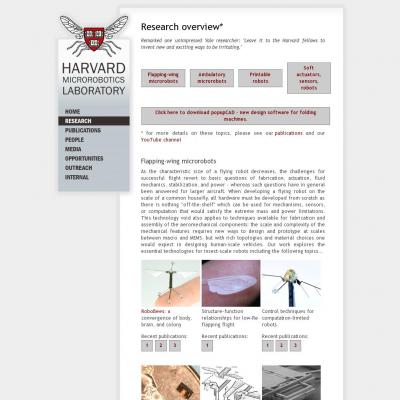 Аналитический обзор об этом роботе пчеле на сайте Гарвардском сайте лаборатории микророботов. Аналитический обзор об этом роботе пчеле на сайте Гарвардском сайте лаборатории микророботов. |


Remarked one unimpressed Yale researcher: "Leave it to the Harvard fellows to invent new and exciting ways to be irritating."
* for more details on these topics, please see our publications and our YouTube channel
Flapping-wing microrobots

As the characteristic size of a flying robot decreases, the challenges for successful flight revert to basic questions of fabrication, actuation, fluid mechanics, stabilization, and power - whereas such questions have in general been answered for larger aircraft. When developing a flying robot on the scale of a common housefly, all hardware must be developed from scratch as there is nothing "off-the-shelf" which can be used for mechanisms, sensors, or computation that would satisfy the extreme mass and power limitations. This technology void also applies to techniques available for fabrication and assembly of the aeromechanical components: the scale and complexity of the mechanical features requires new ways to design and prototype at scales between macro and MEMS, but with rich topologies and material choices one would expect in designing human-scale vehicles. Our work explores the essential technologies for insect-scale robots including the following topics...
 |  |  |
|---|---|---|
| RoboBees: a convergence of body, brain, and colony | Structure-function relationships for low-Re flapping flight | Control techniques for computation-limited robots |
 |  |  |
|---|---|---|
| Ultra-low mass, high efficiency power and control electronics | Mechanical intelligence: passive control mechanisms | Microfabrication of articulated and actuated microstructures: Pop-up book MEMS |
 |  |  |
|---|---|---|
| System modeling and design | Intermittent flight:morphology and controls for effective gliding and flapping | Experimental fluid mechanics using at-scale models |
Recent publications: 1 |
Ambulatory microrobots

We have demonstrated the ability to prototype multi-legged ambulatory robots on the scale of, and inspired by, both insects and myriapods. We use such at-scale prototypes and detailed dynamic models to parameterize the design space for multi-legged robots to optimize subject to various metrics (speed, stability, cost of transport, etc). Two examples are outlined below: the smallest fully autonomous hexapod robot and a centipede-inspired robot...
 |  |  |
|---|---|---|
| Development of hexapod-inspired autonomous robots | Energy density optimized actuation for centimeter-scale autonomous robots | Myriapod-like robots and the study of many-legged locomotion |
Soft actuators, sensors, and robots

As our fabrication methods for microrobots evolved to include a greater diversity of materials, we began pursuing a new class of robots: soft robots. This is a paradigm shift since robots are traditionally thought of as precise and fast, due in part to structural rigidity, high force/torque actuators, and a large variety of available sensors. Robots based on soft materials may not share these traits, however we believe that soft robots enable new opportunities for robotics. Projects in this area include Active soft materials (materials that embed electrical or mechanical functionality in materials that are inherently soft, with characteristic modulus on the order of 100kPa to 1MPa), soft-bodied robots, and programmable materials...
 |  |  |
|---|---|---|
| Programmable matter - self folding sheets of 'robotic origami' | Soft functional materials:hyperelastic sensors and actuators | Assistive soft orthotics and wearable human-computer interfaces |
Click here for high-quality version of "Soft Artificial Skin".
Harvard | SEAS | Wyss Institute | Privacy Policy | Site Map | Contact
Copyright © 2011 Harvard Microrobotics Laboratory


Меня зовут Валера и я хочу запустить 2 вирусных идеи, которые искал уже давно, ЧТОБЫ ИЗМЕНИТЬ ЧТО-ТО В ЭТОМ МИРЕ.
Во-первых это символ +2800 значение которого совершенно противоположно +100500: 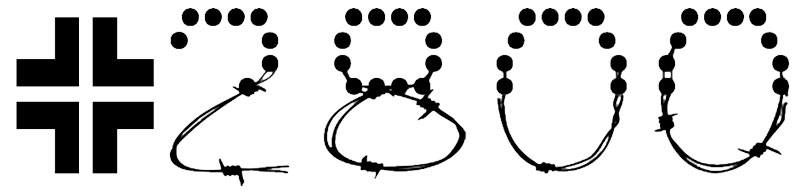
И он для того, чтобы рассказать о еврейском фашизме, 2800 рабах каждому еврею, а главное о каббалистическом языке и каббалистических методах и электронном концлагере который нам готовят и как его избежать. Я думаю многие из вас слышат об этом первый раз и не понимают о чем это я:-) Но это интересно, важно знать каждому и каждому важно рассказывать об этом другим. Подробнее об этом на сайте plus2800.ru. А во-вторых волшебный третий нос на лбу:-) Это как у пастофарианцев друшлак на голове. Во 1-ых это тоже религиозный символ придуманный для того, чтобы рассказать о +2800 и его значениях. Во 2-ых наделяет сверхспособностью о которой мечтал один английский комик. В 3-их он может спасти тому кто его носит жизнь! А в 4-ых его можно использовать как антистресс который всегда под рукой. У учительницы их Химок были проблемы из-за того, что она пришла в школу с друшлаком на голове и вела в таком виде урок. Из-за этого у неё были проблемы и это была разовая акция. А ношение третьего носа можно обосновать и практическими соображениями перечисленными выше. Но при этом все равно все будут знать откуда взялась такая мода, для чего и какие смыслы несет. И подробней об этом на сайте plus2800.ru. А самое главное, что когда я начинал этот проект, то думал что люди верят в религиозную чушь, потому что не знают о лжи и преступлениях церквей и если им рассказать, то они перестанут верить. Но на самом деле ни х.... И многие готовы верить в это, поддерживать это или по крайней мере относиться нейтрально, потому что думают что хоть это и ложь, но ложь полезная и выгодная, поэтому пусть будет. Хм... Возможно поможет если объяснить, что это вредная ложь и они то как раз и создают проблемы, которые решают. Но как ни странно это тоже малоэффективно. А знаете в чем причина? Людей зазомбировали и научили так, что им кажется. что они думают сами, а на самом деле думают чужими мыслями и никакие аргументы и факты ничего не изменят. Вот если телевизор скажет и в то, что будут говорить люди вокруг они поверят скорее чем логике и здравому смыслу. Поэтому чтобы они "услышали" логику и здравый смысл, нужно чтобы миллионы людей говорили об этом. И для этого и был придуман волшебный третий нос на лбу. И вот если миллионы, десятки миллионов, сотни миллионов будут носить волшебный третий нос и рассказывать о том, что зашифровано в символе +2800, то они вдруг услышат здравый смысл и логике и вдруг они "поймут"... Хотя на самом деле нет, а просто опять поверят авторитету. Но в принципе это на данном этапе и не важно - главное результат. Но в общем идея такая и подробнее об этом на сайте plus2800.ru |

|
Скачать все эти страницы с ссылками и привязанными к ним файлами |
 |
|||
|
|