ID_438:ID2_817 :: Копия содержания
страницы:
ID_438:ID2_817 :: Копия содержания
страницы: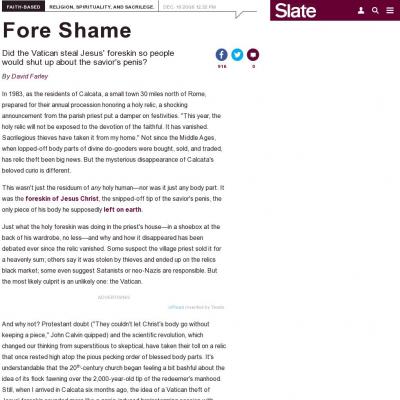 Статья о краже крайней плоти Иисуса Христа в 1983 году.
  цитаты (слов ~ 107).
 Скрыть
Fore Shame
Did the Vatican steal Jesus' foreskin so people would shut up about the savior's penis?

In 1983, as the residents of Calcata, a small town 30 miles north of Rome, prepared for their annual procession honoring a holy relic, a shocking announcement from the parish priest put a damper on festivities. "This year, the holy relic will not be exposed to the devotion of the faithful. It has vanished. Sacrilegious thieves have taken it from my home." Not since the Middle Ages, when lopped-off body parts of divine do-gooders were bought, sold, and traded, has relic theft been big news. But the mysterious disappearance of Calcata's beloved curio is different.
This wasn't just the residuum of any holy human—nor was it just any body part. It was the foreskin of Jesus Christ, the snipped-off tip of the savior's penis, the only piece of his body he supposedly left on earth.
Just what the holy foreskin was doing in the priest's house—in a shoebox at the back of his wardrobe, no less—and why and how it disappeared has been debated ever since the relic vanished. Some suspect the village priest sold it for a heavenly sum; others say it was stolen by thieves and ended up on the relics black market; some even suggest Satanists or neo-Nazis are responsible. But the most likely culprit is an unlikely one: the Vatican.
And why not? Protestant doubt ("They couldn't let Christ's body go without keeping a piece," John Calvin quipped) and the scientific revolution, which changed our thinking from superstitious to skeptical, have taken their toll on a relic that once rested high atop the pious pecking order of blessed body parts. It's understandable that the 20th-century church began feeling a bit bashful about the idea of its flock fawning over the 2,000-year-old tip of the redeemer's manhood. Still, when I arrived in Calcata six months ago, the idea of a Vatican theft of Jesus' foreskin sounded more like a ganja-induced brainstorming session with Dan Brown and Danielle Steele. But some transplanted bohemians, a deathbed confession, and a little historical context have convinced me otherwise.
Even before its disappearance, the relic had a strange history. It was discovered in Calcata in 1557, and a series of miracles soon followed (freak storms, perfumed mists engulfing the village). The church gave the finding a seal of approval by offering a 10-year indulgence to those who came to venerate. Lines of pilgrims stretched from the church doors to beyond the walls of the fortress town. Nuns and monks from nearby villages and monasteries made candlelit processions. Calcata was a must-see destination on the pilgrimage map.
That is, until 1900. Facing increasing criticism after the "rediscovery" of a holy foreskin in France, the Vatican decreed that anyone who wrote about or spoke the name of the holy foreskin would face excommunication. And 54 years later, when a monk wanted to include Calcata in a pilgrimage tour guide, Vatican officials didn't just reject the proposal (after much debate). They upped the punishment: Now, anyone uttering its name would face the harshest form of excommunication—"infamous and to be avoided"—even as they concluded that Calcata's holy foreskin was more legit than other claimants'.
But that wasn't the end of the holy foreskin. In the late 1960s, government officials, worried that crumbling cliffs and threatening earthquakes might doom the village, decided to build a new town. Hippies discovered the newly abandoned town, which was awaiting a government wrecking crew, and squatted in, then legally purchased, the vacated buildings. Some of the bohemian transplants were intrigued by Calcata's relic, which was now only shown to the public during the village's annual New Year's Day procession (even though the Vatican II reforms removed the Day of the Holy Circumcision from the church calendar). The new residents began writing about the quirky event and relic for newspapers in and around Rome, and Calcata's scandalous prepuce was isolated no more. And the church took notice.
Was this the reason Dario Magnoni, the local priest, brought the relic from the church to his home? Who knows. Magnoni refuses to speak about the relic, citing the 1954 threat of excommunication. Magnoni's predecessor, Mario Mastrocola, didn't want to talk about the relic, either, but when asked if he was surprised to hear it had been stolen, he shook his head. When pressed, he said, "The relic would not have been taken away from Calcata if I were still the priest there."
Mastrocola's ambiguous words—while not directly incriminating anyone—hinted at underhanded church dealings (interview requests with the Vatican went unanswered). And later, I found myself sitting in a wine cellar halfway up the hill between the old and new villages of Calcata. Capellone, the cellar's owner and a lifelong Calcatese, told me about his close relationship with a former local bishop, Roberto Massimiliani. Ailing in bed, the bishop told Capellone that when he was gone, so too would be the relic. Bishop Massimiliani passed away soon after, in 1975. Eight years after that, the relic disappeared. "To me, it almost felt like a confession," said Capellone. "Like he needed to tell someone before he died."
Could the "sacrilegious thieves" Magnoni mentioned in his 1983 announcement about the relic's disappearance actually have been Vatican emissaries? The thought of masked, black-clad Vatican agents on a mission to steal Jesus' foreskin does sound alluring. But for residents like Capellone, who swear the Vatican now has the relic, the thief could be Magnoni himself. Some locals claim they saw him go to Rome the day before he made the announcement, generating speculation that the Vatican asked for it and Magnoni not only failed to stand up to them, he delivered the relic himself.
Sold, stolen, or delivered to the Vatican—or even all three—the holy foreskin of Calcata is probably gone for good, even as some residents persist in the hope that it will return. And the church is certainly breathing a sigh of relief. While most of the other copies of the relic were destroyed during the Reformation and the French Revolution, Calcata's holy foreskin lived long past its expiration date, like a dinosaur surviving the meteoric blast of the scientific revolution.
But if it had survived, it would have been only a matter of time before someone wanted to clone it. And that could have given the Second Coming an entirely new meaning.


 North Carolina May Ban Tesla Sales To Prevent “Unfair Competition”
 Obama’s War on Journalists: His Administration’s Leak Investigations Are Outrageous and Unprecedented
 Obama Is Making the Case for Conservatism Better Than Mitt Romney Ever Did
MORE FROM SLATE
FROM AROUND THE WEB
- Creating Confidence in Singing (fromCoreSinging)
- A night at Purgatory Pizza with Father John Misty (from Swimmingly)
- The Funniest Drunk Texts (from Runt of the Web)

SPONSORED FROM AROUND THE WEB


David Farley is the author of An Irreverent Curiosity: In Search of the Church's Strangest Relic in Italy's Oddest Town.
Image of Jesus on Slate's home page from Wikipedia.
LOG IN/REGISTER

Length: 0 characters (Max: 5000)
Click here to load comments.