ID_348:ID2_1366 :: Копия содержания
страницы:
ID_348:ID2_1366 :: Копия содержания
страницы: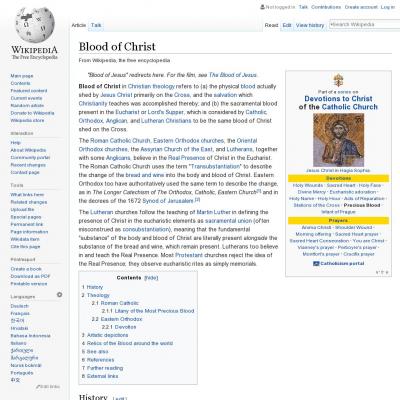 «Blood of Christ» Wikipedia «Blood of Christ» Wikipedia |
Blood of Christ in Christian theology refers to (a) the physical blood actually shed by Jesus Christ from the foreskin and later on the Cross, and the salvation which Christianity teaches was accomplished thereby; and (b) the sacramental blood present in the Eucharist, which is considered by Catholic, Orthodox, Anglican, and Lutheran Christians to be the same blood of Christ shed on the Cross. The Catholic Church, as well as the Eastern Orthodox, Oriental Orthodox, Anglican, and Lutheran churches, believe that in the Eucharist, the faithful receiveJesus' literal blood under the species of wine.
The Catholic Church, Eastern Orthodox churches, the Oriental Orthodox churches, theAssyrian Church of the East, and Lutherans, together with some Anglicans, believe in theReal Presence of Christ in the Eucharist. The Catholic Church uses the term "Transubstantiation" to describe the change of the bread and wine into the body and blood of Christ. Eastern Orthodox too have authoritatively used the same term to describe the change, as in The Longer Catechism of The Orthodox, Catholic, Eastern Church[1] and in the decrees of the 1672 Synod of Jerusalem.[2]
The Lutheran churches follow the teaching of Martin Luther in defining the presence of Christ in the Eucharistic elements as sacramental union (often misconstrued as consubstantiation), meaning that the fundamental "substance" of the body and blood of Christ are literally presentalongside the substance of the bread and wine, which remain present. Lutherans too believe in and teach the Real Presence. Most Protestant churches reject the idea of the Real Presence; they observe Eucharistic rites as simply memorials.
In the early Church, the faithful received the Eucharist in the form of consecrated bread and wine. Saint Maximus[disambiguation needed] explains that in the Old Law the flesh of the sacrificial victim was shared with the people, but the blood of the sacrifice was merely poured out on the altar. Under the New Law, however, Jesus' blood was the drink shared by all of Christ's faithful. St. Justin Martyr, an early Church father of the 2nd century, speaks of the Eucharist as the same body and blood of Christ that was present in His Incarnation.
The tradition continued in the Church in the East to commingle the species of bread and wine, whereas in the West, the Church had the practice of communion under the species of bread and wine separately as the custom, with only a small fraction of bread placed in the chalice. In the West, the communion at the chalice was made less and less efficient, as the dangers of the spread of disease and danger of spillage (which would potentially be sacrilegious) were considered enough of a reason to remove the chalice from common communion altogether, or giving it on only special occasions. However, it was always consecrated and drunk by the priest, regardless of whether or not the laity partook. This was one of the main issues in the Protestant Reformation[citation needed]. As a consequence, the Catholic Church first wanted to eliminate ambiguity, reaffirming that Christ was present both as body and as blood equally under both species of bread and wine. As time went on, the chalice was made more available to the laity. After the Second Vatican Council, the Catholic Church gave a full permission for all to receive communion from the chalice at every Mass involving a congregation, at the discretion of the priest.
See also Shroud of Turin#Blood stains for laboratory researches.
The Catholic Church teaches that the bread and wine, through transubstantiation, become the body, blood, soul and divinity of Christ— in other words, the whole Christ— when consecrated. Precious Blood Prayer: May the most Precious Blood which flowed from the most Holy wounds of our loving Lord Jesus pour over us, to wash, cleanse, purify, heal, guide, and protect us from all evil, harm, sickness, and bless and make us as Holy as we can be. We ask this in the Holy name of Jesus and through His most Precious Blood and His most Holy wounds. Amen.
The devotion to the Precious Blood was an especial phenomenon of Flemish piety in the fifteenth and sixteenth centuries, that gave rise to the iconic image of Grace as the "Fountain of Life," filled with blood, pouring from the wounded "Lamb of God" or the "Holy Wounds" of Christ. The image, which was the subject of numerous Flemish paintings was in part spurred by the renowned relic of the Precious Blood, which had been noted in Bruges at least since the twelfth century[3] and which gave rise, from the late thirteenth century, to the observances, particular to Bruges, of the procession of the "Saint Sang"from its chapel.[4]
The following litany is a part of Roman Catholic devotion to the Precious Blood:
Lord, have mercy on us.
Christ, have mercy on us.
Lord, have mercy on us.
Christ, hear us.
Christ, graciously hear us.
God, the Father of Heaven, have mercy on us.
God the Son, Redeemer of the world, have mercy on us.
God, the Holy Ghost, have mercy on us.
Holy Trinity, One God, have mercy on us.
Blood of Christ, only-begotten Son of the Eternal Father, save us.
Blood of Christ, Incarnate Word of God, save us.
Blood of Christ, of the New and Eternal Testament, save us.
Blood of Christ, falling upon the earth in the Agony, save us.
Blood of Christ, shed profusely in the Scourging, save us.
Blood of Christ, flowing forth in the Crowning with Thorns, save us.
Blood of Christ, poured out on the Cross, save us.
Blood of Christ, price of our salvation, save us.
Blood of Christ, without which there is no forgiveness, save us.
Blood of Christ, Eucharistic drink and refreshment of souls, save us.
Blood of Christ, stream of mercy, save us.
Blood of Christ, victor over demons, save us.
Blood of Christ, courage of Martyrs, save us.
Blood of Christ, strength of Confessors, save us.
Blood of Christ, bringing forth Virgins, save us.
Blood of Christ, help of those in peril, save us.
Blood of Christ, relief of the burdened, save us.
Blood of Christ, solace in sorrow, save us.
Blood of Christ, hope of the penitent, save us.
Blood of Christ, consolation of the dying, save us.
Blood of Christ, peace and tenderness of hearts, save us.
Blood of Christ, pledge of eternal life, save us.
Blood of Christ, freeing souls from purgatory, save us.
Blood of Christ, most worthy of all glory and honor, save us.
Lamb of God, Who takest away the sins of the world, spare us, O Lord!.
Lamb of God, Who takest away the sins of the world, graciously hear us, O Lord!.
Lamb of God, Who takest away the sins of the world, have mercy on us.
V/. Thou hast redeemed us, O Lord, in Thy Blood.
R/. And made us, for our God, a kingdom.
Let us pray. Almighty and everlasting God, Who didst appoint Thine only-begotten Son the Redeemer of the world, and hast willed to be appeased by His Blood; grant unto us, we beseech Thee, so to venerate (with solemn worship) the price of our redemption, and by its power be so defended against the evils of this life, that we may enjoy the fruit thereof forevermore in Heaven. Through the same Our Lord Jesus Christ, Thy Son, Who liveth and reigneth with Thee in the unity of the Holy Ghost, God, world without end. R/. Amen.
The Orthodox teach that what is received in Holy Communion is the actual Resurrected Body and Blood of Jesus Christ. In the West, the Words of Institution are considered to be the moment at which the bread and wine become the Body and Blood of Christ. But for the Orthodox there is no one defined moment; rather, all that Orthodox theology states is that by the end of the Epiklesis, the transformation has been completed. The Orthodox also do not use the theological termTransubstantiation to define the conversion from bread and wine into the Body and Blood of Christ, they use the wordmetaousia without the precise theological elaboration that accompanies the term trabsubstantiation..
According to Saint John Damascene, the Sacred Mysteries (under the form of bread and wine) do not become incorruptible until they are actually received in faith by a believing Christian in a state of grace.
In the Eastern Orthodox churches, and those Eastern Catholic Churches which follow the Byzantine Rite, there is no individual devotion to the Blood of Christ separate from the Body of Christ, or separated from the reception of Holy Communion.
When receiving Holy Communion, the clergy (deacons, priests and bishops) will receive the Body of Christ separately from the Blood of Christ. Then, the remaining portions of the consecrated Lamb (Host) is divided up and placed in the chalice and both the Body and Blood of Christ are communicated to the faithful using a liturgical spoon (see also Intinction).
 Sollier, J.F. (1913). "Precious Blood". Catholic Encyclopedia. New York: Robert Appleton Company.
Меня зовут Валера и я хочу запустить 2 вирусных идеи, которые искал уже давно, ЧТОБЫ ИЗМЕНИТЬ ЧТО-ТО В ЭТОМ МИРЕ.
Во-первых это символ +2800 значение которого совершенно противоположно +100500: 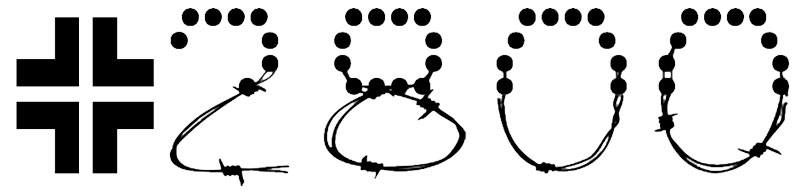
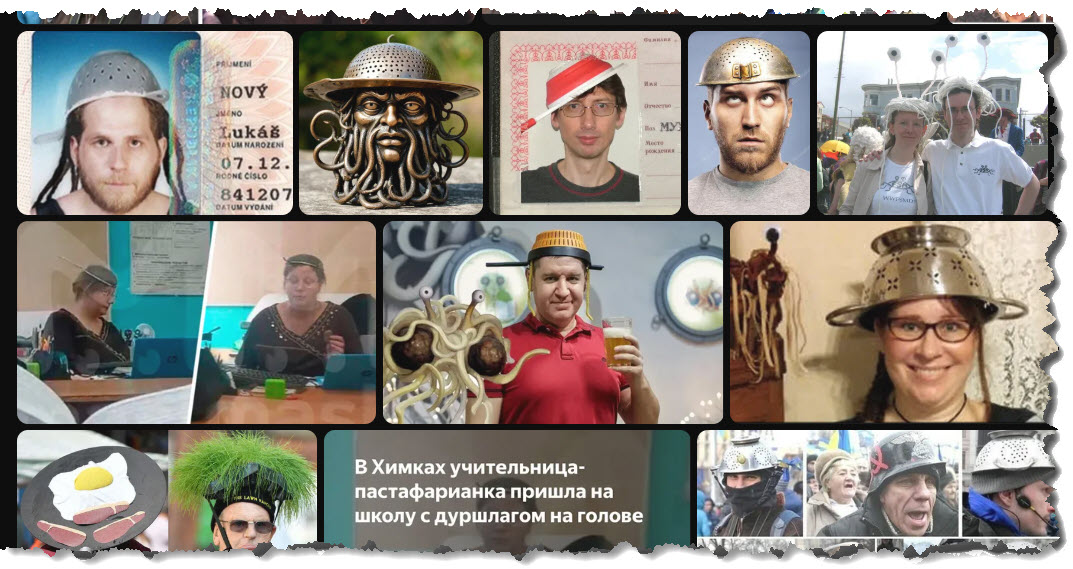
И он для того, чтобы рассказать о еврейском фашизме, 2800 рабах каждому еврею, а главное о каббалистическом языке и каббалистических методах и электронном концлагере который нам готовят и как его избежать. Я думаю многие из вас слышат об этом первый раз и не понимают о чем это я:-) Но это интересно, важно знать каждому и каждому важно рассказывать об этом другим. Подробнее об этом на сайте plus2800.ru. А во-вторых волшебный третий нос на лбу:-) Это как у пастофарианцев друшлак на голове. Во 1-ых это тоже религиозный символ придуманный для того, чтобы рассказать о +2800 и его значениях. Во 2-ых наделяет сверхспособностью о которой мечтал один английский комик. В 3-их он может спасти тому кто его носит жизнь! А в 4-ых его можно использовать как антистресс который всегда под рукой. У учительницы их Химок были проблемы из-за того, что она пришла в школу с друшлаком на голове и вела в таком виде урок. Из-за этого у неё были проблемы и это была разовая акция. А ношение третьего носа можно обосновать и практическими соображениями перечисленными выше. Но при этом все равно все будут знать откуда взялась такая мода, для чего и какие смыслы несет. И подробней об этом на сайте plus2800.ru. А самое главное, что когда я начинал этот проект, то думал что люди верят в религиозную чушь, потому что не знают о лжи и преступлениях церквей и если им рассказать, то они перестанут верить. Но на самом деле ни х.... И многие готовы верить в это, поддерживать это или по крайней мере относиться нейтрально, потому что думают что хоть это и ложь, но ложь полезная и выгодная, поэтому пусть будет. Хм... Возможно поможет если объяснить, что это вредная ложь и они то как раз и создают проблемы, которые решают. Но как ни странно это тоже малоэффективно. А знаете в чем причина? Людей зазомбировали и научили так, что им кажется. что они думают сами, а на самом деле думают чужими мыслями и никакие аргументы и факты ничего не изменят. Вот если телевизор скажет и в то, что будут говорить люди вокруг они поверят скорее чем логике и здравому смыслу. Поэтому чтобы они "услышали" логику и здравый смысл, нужно чтобы миллионы людей говорили об этом. И для этого и был придуман волшебный третий нос на лбу. И вот если миллионы, десятки миллионов, сотни миллионов будут носить волшебный третий нос и рассказывать о том, что зашифровано в символе +2800, то они вдруг услышат здравый смысл и логике и вдруг они "поймут"... Хотя на самом деле нет, а просто опять поверят авторитету. Но в принципе это на данном этапе и не важно - главное результат. Но в общем идея такая и подробнее об этом на сайте plus2800.ru |

|
Скачать все эти страницы с ссылками и привязанными к ним файлами |
 |
|||
|
|