ID_970:ID2_10381 :: Копия содержания
страницы:
ID_970:ID2_10381 :: Копия содержания
страницы: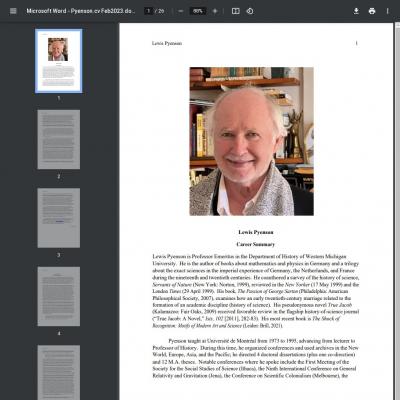 Льюис Пайенсон - почетный профессор исторического факультета Университета Западного Мичигана. Он является автором книг о математике и физике в Германии и трилогии о точных науках в имперском опыте Германии, Нидерландов и Франции в девятнадцатом и двадцатом веках. Он был соавтором обзора истории науки "Слуги природы" (Нью-Йорк: Norton, 1999), опубликованного в " New Yorker" (17 мая 1999) и лондонской " Times" (29 апреля 1999). В его книге " Страсть Джорджа Сартона" (Филадельфия: Американское философское общество, 2007) рассматривается связь брака начала двадцатого века с формированием академической дисциплины (истории науки). Его роман под псевдонимом "Настоящий Джейкоб " (Kalamazoo: Fair Oaks, 2009) получил благоприятную рецензию в ведущем журнале по истории науки ("Настоящий Джейкоб: роман", Isis, 102 [2011], 282-83). Его последняя книга - "Шок от признания: мотивы современного искусства и науки" (Лейден: Брилл, 2021). Льюис Пайенсон - почетный профессор исторического факультета Университета Западного Мичигана. Он является автором книг о математике и физике в Германии и трилогии о точных науках в имперском опыте Германии, Нидерландов и Франции в девятнадцатом и двадцатом веках. Он был соавтором обзора истории науки "Слуги природы" (Нью-Йорк: Norton, 1999), опубликованного в " New Yorker" (17 мая 1999) и лондонской " Times" (29 апреля 1999). В его книге " Страсть Джорджа Сартона" (Филадельфия: Американское философское общество, 2007) рассматривается связь брака начала двадцатого века с формированием академической дисциплины (истории науки). Его роман под псевдонимом "Настоящий Джейкоб " (Kalamazoo: Fair Oaks, 2009) получил благоприятную рецензию в ведущем журнале по истории науки ("Настоящий Джейкоб: роман", Isis, 102 [2011], 282-83). Его последняя книга - "Шок от признания: мотивы современного искусства и науки" (Лейден: Брилл, 2021).* * * б) История современных точных наук. Исследование Пайенсона Молодой Эйнштейн: появление теории относительности (Адам Хилгер, Бристоль и Бостон, 1985) появилось за несколько лет до выхода первого тома Собрания сочинений Альберта Эйнштейна. С тех пор небольшая армия редакторов, изучающих подробности ранней жизни Эйнштейна, исправила и дополнила его наблюдения. Книга продолжает цитироваться с одобрением беспристрастными учеными (недавно Герберт Ханцикер, "Волшебная гора Альберта Эйнштейна: образование Арау", Физика в перспективе, 17 [2015], 55-69), а также широкой читающей публикой, особенно в исправленном переводе книги на испанский; более ранняя благоприятная рецензия написана Хорхе Каладо в Times Literary Supplement, 14 марта 1986, стр. 283. Также до сих пор цитируется первая короткая книга Пайенсона "неогуманизм и сохранение чистой математики в вильгельмовской Германии"; ранние положительные рецензии на нее: Герберт Мертенс, "Анналы науки", 43 (1986), 200-201; Дэвид Вампола, Кос (Милан, Италия), 1 (сентябрь 1984), 21-22; Бернхард фон Броке, "Die Gelehrten", "Историко-политическая книга", 31 Октябрь 1983 года, стр. 305-308. Он провел систематическую просопографию докторантов гуманитарных и естественных наук Л. Пайенсона и Дугласа Скоппа. "Обучение физиков в Германии около 1900 года", Social Studies of Science, 7 (1977), 329-366. В "Революции теории относительности в Германии", в книге "Сравнительная рецепция теории относительности", Томас Глик, изд. (Бостон / Дордрехт: Рейдель, 1987), стр. 59-111, он сравнивает Французскую революцию с ранним восприятием теории относительности в Германии и показывает, как Макс Планк поощрял своих докторантов обращаться к работе Эйнштейна. |
Lewis Pyenson 1

Lewis Pyenson is Professor Emeritus in the Department of History of Western Michigan University. He is the author of books about mathematics and physics in Germany and a trilogy about the exact sciences in the imperial experience of Germany, the Netherlands, and France during the nineteenth and twentieth centuries. He coauthored a survey of the history of science, Servants of Nature (New York: Norton, 1999), reviewed in the New Yorker (17 May 1999) and the London Times (29 April 1999). His book, The Passion of George Sarton (Philadelphia: American Philosophical Society, 2007), examines how an early twentieth-century marriage related to the formation of an academic discipline (history of science). His pseudonymous novel True Jacob (Kalamazoo: Fair Oaks, 2009) received favorable review in the flagship history-of-science journal ("True Jacob: A Novel," Isis, 102 [2011], 282-83). His most recent book is The Shock of Recognition: Motifs of Modern Art and Science (Leiden: Brill, 2021).
Pyenson taught at Universite de Montreal from 1973 to 1995, advancing from lecturer to Professor of History. During this time, he organized conferences and used archives in the New World, Europe, Asia, and the Pacific; he directed 4 doctoral dissertations (plus one co-direction) and 12 M.A. theses. Notable conferences where he spoke include the First Meeting of the Society for the Social Studies of Science (Ithaca), the Ninth International Conference on General Relativity and Gravitation (Jena), the Conference on Scientific Colonialism (Melbourne), the
Sixteenth International Congress of History of Science (Bucharest), the founding Congress of the Latin American Society of the History of Science and Technology (Puebla), the first Conference on the History of Physics of the European Physical Society (Pavia), the Fourth International Colloquium on Sinology (Chantilly), New Trends in the History of Science (Utrecht), the eightieth anniversary of the Junta para la Ampliation de Estudios e Investigaciones Cientificas (Madrid), the Eighteenth International Congress of History of Science (Hamburg/Munich), Sciences and Empires (CNRS/UNESCO, Paris), and the Fiftieth Anniversary of UNESCO Conference on the History of Science (Paris). He received the Herbert C. Pollock Award of the Dudley Observatory (Schenectady) in 1986. Recipient of a number of federal Canadian research grants, in 1989-1991 he was named a Killam Senior Fellow of the Canada Council of Arts. In 1994 he was elected Fellow of the Royal Society of Canada.
From 1995 to 2001 he was Graduate Dean at University of Louisiana at Lafayette (Universite des Acadiens), where he supervised doctoral production to maintain the university's Carnegie status and stimulated research activity by organizing internal publications and events. He saw the inception of doctoral programs in Francophone Studies and Cognitive Science, and the closure of a doctoral program in Statistics. He chaired the Conference of Southern Graduate Schools and sat on its prize committee. Moving to the faculty from 2001 to 2006, he was Professor of History with cross-appointments in Francophone Studies, Mathematics, Physics, and Computer Sciences.
During 11 years in Louisiana, he spoke at the United Nations/European Space Agency Workshop on Basic Space Science (Cordoba, Argentina), the Seventh International History Colloquium, Universidad de Navarra (Pamplona), the Fifth European Colloquium on Ethnopharmacology (Valencia), the International Colloquium on Emile Masson (Pontivy, France), and the Twenty-Second International Congress of History of Science (Beijing). He was elected to the Phi Beta Delta and Phi Kappa Phi honor societies and named Honorary Member of the Arbeitskreis Geschichte Geophysik und kosmische Physik, Germany. He received the Silver Award of the University and College Design Association for his edited book, Fortiter, Feliciter, Fideliter: The Centennial Lectures of the Graduate School of the University of Southwestern Louisiana (renamed the University of Louisiana at Lafayette in 1999), and the Award for Outstanding Achievement in Research of the Canadian Museums Association for his two co-edited books. The Art of Teaching Physics: The Eighteenth Century Demonstration Apparatus of Jean Antoine Nollet/ L'art d'enseigner la physique: Les appareils de demonstration de Jean-Antoine Nollet (1700-1770) (Sillery, Quebec: Septentrion for the David M. Stewart Museum, 2002). He was given the Richard G. Neiheisel Phi Beta Kappa Award in Arts and Sciences (University of Southwestern Louisiana). In 1996, he was Suntory Lecturer in Japan (universities of Tokyo, Tohoku, Kyoto, and Tokai) and in 2005 held the George Sarton Chair at Ghent University, Belgium. Also in 2005, he received for a second time the Herbert C. Pollock Award of the Dudley Observatory and was elected Corresponding Member of the International Academy of the History of Science. In 2001-2004, he sat on the Konrad Adenauer Award Committee, Royal Society of Canada.
In 2006 Pyenson became Graduate Dean at Western Michigan University, which position he held until 2010 under 3 presidents and 4 provosts. There he focused on recruitment and
retention of students, on faculty morale, and generally on procedures and standards. He supervised the university's participation in the National Academies' Data-Based Assessment of Research-Doctorate Programs (Washington DC: National Academies Press, 2011). Conference lectures during this time were delivered at: Analogous Spaces: Architecture and the Space of Information, Intellect and Action (Ghent), Science and the Colonies around 1808 (Royal Netherlands Academy of Sciences), 150th Anniversary Conference on Henri Pirenne (Brussels/Ghent), Empires of Science in the Long Nineteenth Century (Huntington Library), Travels and Scientific Expeditions in Latin America (Centro Franco-Argentino de Altos Estudios de la Universidad de Buenos Aires), and A Mathematician's Journeys: Otto Neugebauer between History and Practice of the Exact Sciences (New York). He sat on the Habilitation jury of Pascal Crozet in Paris (Dr Crozet is now directeur de recherches, CNRS, Paris).
Pyenson returned to the faculty in 2011 as Professor of History. Among his notable conference lectures beginning in 2011 were those at the Forty-Sixth International Congress on Medieval Studies (Kalamazoo), Thinking Shadows: The Art of Memory and Morphogenesis of Ideal Entities (Bologna), the Transatlantic Studies Association (Ghent), the Sixth Annual Conference of the History of the Humanities (Oxford), European Society for the History of Science (London), Seeking a New Conception of Science: The Future of Scientific Culture in East Asia (Chubu University, Japan), and the Seventh World Congress and School on Universal Logic (Orthodox Academy of Crete, Greece). He sat on the doctoral committee of Joris Mercelis at Ghent (Dr Mercelis is now Assistant Professor of History of Science and Technology, Johns Hopkins University).
In the year that he became Professor Emeritus, 2020, the non-profit, open-access search engine exaly finds that across his lifetime Pyenson is the most published author in Isis (History of Science Society) and in the British historiographical journal History of Science, and the third-most cited author in the latter (https://exaly.com/author/9636130/lewis-pyenson/rankings). He continues to direct a doctoral dissertation at Western Michigan University about sugar engineers in the Colonial Atlantic World.
December 2022
Lewis Pyenson is Professor Emeritus in the Department of History of Western Michigan University. He is the author of books about mathematics and physics in Germany and a trilogy about the exact sciences in the imperial experience of Germany, the Netherlands, and France during the nineteenth and twentieth centuries. He coauthored a survey of the history of science, Servants of Nature. His scholarly book, The Passion of George Sarton, examines how an early twentieth-century marriage related to the formation of an academic discipline. His most recent book is The Shock of Recognition: Motifs of Modern Art and Science (Leiden: Brill, 2021).
The trilogy appeared over the course of nine years: Civilizing Mission: Exact Sciences and French Overseas Expansion, 1830-1940 (The John Hopkins University Press, Baltimore and London 1993); Empire of Reason: Exact Sciences in Indonesia, 1840-1940 (E.J. Brill, Leiden 1989); and Cultural Imperialism and Exact Sciences: German Expansion Overseas 1900-1930 (Peter Lang, New York 1985). It generated a great deal of interest from the time that the project took shape in the 1970s (Pyenson, "The Incomplete Transmission of a European Image: Physics at Greater Buenos Aires and Montreal, 1890-1920," Proceedings of the American Philosophical Society, 122 [1978], 92-114). One of his conclusions, that the exact sciences in the nineteenth and early twentieth centuries did not change form in the overseas ambits of the European imperialist powers, gave rise to an unprovoked attack and a disagreeable exchange in Isis (Pyenson's reply: "Cultural Imperialism and Exact Sciences Revisited," Isis, 84 [1993], 103-108). But even these severe critics did not challenge the typology of scientist-imperialists that he discovered, and the verdict of a large number of balanced assessments of his enterprise is favorable. Four reviews, from many score more, indicate the impact of the trilogy. Anne Rasmussen, historian at the University of Strasbourg, wrote in 1998 after the appearance of the third, French volume that "the pioneering and sustained work of L. Pyenson.. .retain a prominent, distinctive interpretation." The third volume's "great merit" is "to reveal many figures in full [who are] traced in a mass of biographical sources." It "describes very well the terms of the social contract that connect scientists to the empire." Lewis Pyenson was "the first to have risked a synthesis about French colonial science and to have proposed a working interpretation still unequalled." (Rasmussen in Annales: Histoire, Sciences Sociales, 53 [1998], 1001-1003). Patrick Petitjean, an authority on science and colonization in the CNRS (Paris), looking forward to more work devoted to the descriptive sciences in the French empire, wrote that the third volume "is the first systematic book about French colonial sciences," and it shows that colonial science is "far more important than previously reported from historians of colonization as well as from historians of science and technology." (Petitjean in Annals of Science, 52 (1995), 187-192). Australian social anthropologist Clive Kessler, in a long commentary on the second, Dutch volume, emphasized the subtlety of the argument:
Not a conspiracy, then, nor even an impersonal, structurally induced convergence of diverse influences all working broadly in the same direction, cultural imperialism for Pyenson is rather the outcome of the untidy, even inchoate, clash of a variety offorces of variable strengths pulling unevenly in different directions and varying over time in salience and also in their clarity of articulation.
Kessler continued: "The agenda of Dutch colonial scientific endeavor explored by Pyenson was an impressive one, international in its horizons and in the recognition its distinctions earned." He perceived Pyenson's contention that science and imperialism could be understood
By recourse to...MichelFoucault's ideas on the shaping of power by, and its immanence in, scientific and disciplinary discourses; and Clifford Geertz's arguments that, far from emerging from any pre-existing 'givens' of power, .simply to rationalize and ratify its purposes, culture enters into the very shaping, and is thus constitutive, of power itself.
(Kessler, "Colonial Science and the Creation of a Postcolonial Scientific Tradition in Indonesia," Akademika: Journal of Southeast Asia Social Sciences and Humanities [Universiti Kebangsaan Malaysia Press], 37 [December 1990], 91-105). And the historian of medicine Jose Maria Lopez Pinero, reviewing Pyenson's work in connection with linguistic imperialism in Europe, wrote that "assimilating with care the explanations and the conclusions of Pyenson's works about scientific imperialism will be of significant benefit for studies of scientific activity in Spain." (Lopez Pinero, "El imperialismo cientifico," Saber/Leer [Madrid], no. 81 [January 1995], p. 12).
The general work written with Susan Sheets-Pyenson, Servants of Nature: A History of Scientific Institutions, Enterprises, and Sensibilities (HarperCollins, London/W. W. Norton, New York 1999), also received favorable comment from an unusually broad spectrum of reviewers. In one of its very few reviews of a book in history of science, the New Yorker (17 May 1999, p. 91) commented: "The book's inclusiveness helps us recognize not only how science affects everything, from daily life to government budgets, but also the way we think about everything, from politics to poetry." The literary reviewer Peter Ackroyd finds that "One of the strengths of this volume, in fact, is the extent to which it illuminates how science alters according to the country or culture in which it is practiced." (Ackroyd in London Times, 29 April 1999). In 2012 sociologist Steve Fuller reviewed the second volume of Peter Burke's Social History of Knowledge, comparing it to Servants of Nature, "a work of similar scope and vintage" with "a more overtly philosophical and specifically Marxist flavor." Fuller elaborated: "The Pyensons are mainly interested in the materiality of knowledge as an ideological conduit," concluding "on the worry that the often violent modes of domination through which science advances is breeding an ideological backlash that may soon undermine the enterprise [sic]." (Fuller in Journal of Global History, 7 [2012], 534). No Marxist, the dean of US historians of science Charles C. Gillispie emphasized a decade earlier: "Their introduction is a masterly brief survey of the evolution of historiography of science from Comte to postmodernism, about which they are severe, justly in my view." About the work in general, "the most appealing feature is the deftness with which they handle a comparative approach, selecting both the common features and the distinctive differences in the cultivation of science throughout the ages in Europe, the Orient, India, and Islam." It is a "masterly and wide-ranging.. .book, conceived in an altogether original manner, carried off with verve and dignity, and mercifully free of jargon and methodology." (Gillispie in Annals of Science, 59 [2002], 409-412). The stern critic Paula Findlen devoted four pages to rehabilitating postmodernist scholarship and informing a reader about themes that she would have preferred to see, but she concluded that the book is "a valuable contribution to the general history of science." (Findlen in Isis, 91 [2000], 117-120).
Pyenson's scholarly publications divide into four groups: a) historiography; b) history of modern exact sciences; c) science beyond Europe; d) art and science in Modernity.
a) Historiography. He has contributed regularly to historiography since his early publication, "'Who the Guys Were': Prosopography in the History of Science," History of Science, 15 (1977), 155-188. More recently is The Passion of George Sarton: A Modern Marriage and Its Discipline (American Philosophical Society, Philadelphia 2007). Following the appearance of the book, Sartonian themes were elaborated with Christophe Verbruggen: Sarton's close connection with Nobel-laureate Henri La Fontaine (Pyenson and Verbruggen, "Ego and the International: The Modernist Circle of George Sarton," Isis, 100 [2009], 60-78); his relationship with historian Henri Pirenne (Pyenson and Verbruggen, "Elements of the Modernist Creed in Henri Pirenne and George Sarton," History of Science, 49 [2011], 377-394); and Sarton's key role in the foundation of the worldview of the controversial Belgian first minister Hendrik De Man (Verbruggen and Pyenson, "History and the History of Science in the Work of Hendrik De Man," Belgisch Tijdschrift voor Nieuwste Geschiedenis, 41 [2011], 487-511). Recently he collaborated with Chinese scholars examining the surprisingly similar sensibilities of George Sarton and the linguist and musicologist Yuen Ren Chao: Dian Zeng, Jian Yang, and L. Pyenson. "Compatible Humanists: Yuen Ren Chao Meets George Sarton," Isis, 110 (2019), 742-753. With Roshdi Rashed, he looked into Otto Neugebauer as a historian (Rashed and Pyenson, "Otto Neugebauer, Historian," History of Science, 50 [2012], 402-431). He wrote about the Enola Gay controversy at the National Air and Space Museum (Washington, DC) for Japanese readers: Pyenson, "Western Wind: The Atomic Bomb in American Memory," Historia Scientiarum, 6, no. 3 (1997), 231-241. He has lectured on Mabel Sarton as a talented designer-entrepreneur. His interaction with the late woman of letters, May Sarton, is described in her last writings (May Sarton, Selected Letters, 1955-1995, ed. Susan Sherman [Norton, New York 2002]). He has recently published "Sobre o Estilo na Historia Intelectual," Khronos, Revista de Histdria da Ciencia (Sao Paulo), n° 14 (January 2023), 1-43, translated and introduced by Gildo Magalhaes dos Santos Filho: https://www.revistas.usp.br/khronos/article/view/207935/191245
b) History of modern exact sciences. Pyenson's study The Young Einstein: The Advent of Relativity (Adam Hilger, Bristol and Boston 1985) appeared several years before the first volume of the Collected Papers of Albert Einstein. Since then, a small army of editors combing through the details of Einstein's early life have corrected and amplified his observations. The book continues to be cited with approval by dispassionate scholars (recently Herbert Hunziker, "Albert Einstein's Magic Mountain: An Aarau Education," Physics in Perspective, 17 [2015], 55-69), and by the general reading public, notably in the book's revised Spanish translation; an older favorable review is by Jorge Calado in Times Literary Supplement, 14 March 1986, p. 283. Pyenson's first short book, Neohumanism and the Persistence of Pure Mathematics in Wilhelmian Germany, is also still cited; early favorable reviews of it: Herbert Mehrtens, Annals of Science, 43 (1986), 200-201; David Vampola, Kos (Milan, Italy), 1 (September 1984), 21-22; Bernhard vom Brocke, "Die Gelehrten," Das Historisch-Politische Buch, 31 October 1983, pp. 305-308. He carried out a systematic prosopography of doctoral students across the human and natural sciences in L. Pyenson and Douglas Skopp. "Educating Physicists in Germany circa 1900," Social Studies of Science, 7 (1977), 329-366. In "The Relativity Revolution in Germany," in The Comparative Reception of Relativity, Thomas Glick, ed. (Boston/Dordrecht: Reidel, 1987), pp. 59-111, he compares the French Revolution to the early reception of relativity in Germany, and he shows how Max Planck encouraged his doctoral students to address Einstein's work.
c) Science beyond Europe. Older essays on science beyond Europe continue to receive attention: Pyenson, "Macondo cientifico: Instituciones cientfficas en America Latina a principios del siglo
XX," in La Junta para Ampliacion de Estudios e Investigaciones Cientificas 80 anos despues, ed. Jose
Manuel Sanchez Ron, 2 vols; (Consejo Superior de Investigaciones Cientfficas, Madrid 1988), 1, 229-249; Pyenson, "Pure Learning and Political Economy: Science and European Expansion in the Age of Imperialism," in New Trends in the History of Science, ed. R. P. W. Visser, H. J. M. Bos, L. C. Palm, and H. A. M. Snelders (Rodopi, Amsterdam 1989), pp. 209-278; Pyenson, "Why Science May Serve Political Ends: Cultural Imperialism and the Mission to Civilize," Berichte zur Wissenschaftsgeschichte, 13 (1990), 69-81; Pyenson, "The Ideology of Western Rationality: History of Science and the European Civilizing Mission," Science and Education, 2 (1993), 329-343. More recently, he has revealed the surprisingly sophisticated curriculum of science at the University of Cordoba, Argentina, early in the nineteenth century, before the renovations of Domingo Faustino Sarmiento, and the equally sophisticated network of nineteenth-century printers and publishers in Argentina: Pyenson, trans. Gaston Sironi, "Ciencia en Cordoba en el siglo diecinueve," in Universidad Nacional de Cordoba. Cuatrocientos anos de historia, ed. Daniel Saur and Alicia Servetto (2 vols; Editorial de la Universidad Nacional de Cordoba, Cordoba, Argentina 2013), 1: 251-281 (see: Mariana Mendoza, "Antes de Sarmiento se ensenaba ciencia en la Universidad," http://www.unciencia.unc.edu.ar/2012/mayo-1/antes-de-sarmiento ); and he has examined the role of scientists in the Argentine war against autochtones in Patagonia and in George Armstrong Custer's war against Native Americans: Pyenson, "Athena's Retinue: Nineteenth-Century Scientists Embedded in the Army," British Journal for the History of Science, 45 [2012], 377-400). Also notable: Pyenson and Milan Singh. "Physics on the Periphery: A World Survey, 1920-1929," Scientometrics, 6 (1984), 279-306.
d) Art and science in Modernity. Over recent decades he has studied how art relates to science in Modernity. A number of articles have appeared: "The Enlightened Image of Nature in the Dutch East Indies: Consequences of Postmodernist Doctrine for Broad Structures and Intimate Life," Historical Studies in the Natural Sciences, 41 (2011), 1-40; "The Einstein-Picasso Question: Neo-Idealist Abstraction in the Decorative Arts and Manufactures," Historical Studies in the Natural Sciences, 43 (2013), 281-333; "Sculpture in the Belle Epoque: Mathematics, Art, and Apparitions in School and Gallery," in Being Modern: The Cultural Impact of Science in the Early Twentieth Century, ed. Robert Bud, Paul Greenhalgh, Frank James, and Morag Shiach (UCL Press, London 2018), 188-206. His comprehensive treatment is The Shock of Recognition: Motifs of Modern Art and Science (Leiden: Brill, 2021), 668 pp., summarized in: "Science in History and Beyond," ChemTexts, 7, no. 1 (2021), 1-7, and reviewed by Jose Emilio Burucua in Prismas: Revista de historia intelectual (Universidad Nacional de Quilmes, Argentina), no. 26 (2022), 285-86. In connection with this enterprise, he has been casting life- sized bronze busts and welding iron sculpture (Pyenson, "Realization in Arts and Sciences," Leonardo, 50, no. 2 [April 2017], 21719). As part of an engagement with the arts generally, under the pseudonym Tom Stiver he wrote a novel, which became one of the few works of fiction reviewed favorably by Isis (Diane Greco Josefowicz, "True Jacob: A Novel," Isis, 102 [2011], 282-283). A collection on eighteenth-century physics in both French and English versions has also appeared: Pyenson and Jean-Francois Gauvin, ed., The Art of Teaching Physics: The Eighteenth Century Demonstration Apparatus of Jean Antoine Nollet [Sillery, Quebec: Septentrion, for the David M. Stewart Museum, 2002], reviewed by David Bryden in Bulletin of the Scientific Instrument Society, no. 77 [June 2003], 40-41.
Beyond these thematic areas, Pyenson has edited and co-edited a large number of volumes: specialized collections of articles, notably three co-edited volumes, with Russell McCormmach and R. Steven Turner, of Historical Studies in the Physical Sciences (The Johns Hopkins University Press, Baltimore 1977-79); collections for the general scholarly public, notably in his capacity as
Graduate Dean at the University of Louisiana at Lafayette (1995-2001); a translation from Polish (Leopold Infeld, trans. Helen Infeld, ed. Pyenson, Why I Left Canada [McGill-Queen's University Press, Montreal 1978], reviewed by Mark Kac, Science, 6 April 1979, pp. 49-50).
His occasional writings have appeared in a variety of periodicals: Pyenson, "Technology's Triumph Over Science," Chronicle [of Higher Education] Review, 6 March 2011, pp. B4-B5); Nicholas D. Pyenson and L. Pyenson, "Treating Medieval Manuscripts as Fossils," Science, 309 [2005], 698-699); Pyenson, "Without Feathers," Lingua Franca, vol. 9, no. 4 [May-June 1999], pp. 5, 73; Bruce Draine, John Greenly, David Garland, and L. Pyenson, "Supersonic Boom," New Republic, 156, 7 (18 February 1967), pp. 35 ff. His reviews have appeared in a wide range of vehicles.
February 2023
A. Contributions to Periodicals.
A.1. ISI (Web of Knowledge, before Clarivate) periodicals (articles [A], reviews [R], letters [L], notes [N], proceedings papers [P])
130. Pyenson, L. "The Second Physicist: On the History of Theoretical Physics in Germany," Isis, 113 (2022), 194-196. R
129. Pyenson, L. "Science in History and Beyond," ChemTexts, 7, no. 1 (2021), 1-7. A
128. Haubold, Hans J., Arak M. Mathai, and L. Pyenson. "Space Science and Technology Education, Teaching, Research," Space Policy, 53 (2020), Article Number: 101384. A
127. Zeng, Dian, Jian Yang, and L. Pyenson. "Compatible Humanists: Yuen Ren Chao Meets George Sarton," Isis, 110 (2019), 742-753. A
126. Pyenson, L. "Natures in Translation," Isis, 109 (2018), 405-406. R
125. Pyenson, L. "Realization in Arts and Sciences," Leonardo, 50, no. 2 (April 2017), 217-219. A 124. Pyenson, L. "Great Scientists Wage the Great War" Journal of Military History, 80 (2016), 573-575. R 123. Pyenson, L. "War of Guns and Mathematics," Journal of Military History, 80 (2016), 573-575. R 122. Pyenson, L. "Race, Science, and the Nation," American Historical Review, 119 (2014), 1368-1370. R 121. Pyenson, L. "Uncovering the Germanic Past," American Historical Review, 119 (2014), 1368-1370. R
120. Pyenson, L. "The Einstein-Picasso Question: Neo-Idealist Abstraction in the Decorative Arts and
Manufactures," Historical Studies in the Natural Sciences, 43 (2013), 281-333. A
119. Rashed, Roshdi, and L. Pyenson. "Otto Neugebauer, Historian," History of Science, 50 (2012), 402-431. A
118. Pyenson, L. "The Colonial Machine," American Historical Review, 117 (2012), 1671-1672. R
117. Pyenson, L. "Athena's Retinue: Nineteenth-Century Scientists Embedded in the Army," British Journal for the History of Science, 45 (2012), 377-400. A
116. Pyenson, L. "From Man to Ape: Darwinism in Argentina, 1870-1920," Journal of Interdisciplinary History, 42, (2012), 487-489. R
9 19 25
115. Pyenson, L. "El Desierto en una vitrina: Museos e historia natural en la Argentina, 1810-1890,"
Journal of Interdisciplinary History, 42 (2012), 487-489. R
114. Pyenson, L. "Science: A Four-Thousand Year History," Isis, 102 (2011), 744-745. R
113. Pyenson, L., and Christophe Verbruggen. "Elements of the Modernist Creed in Henri Pirenne and George Sarton," History of Science, 49 (2011), 377-394. A
112. Verbruggen, Christophe, and L. Pyenson. "History and the History of Science in the Work of
Hendrik De Man," Belgisch Tijdschrift voor Nieuwste Geschiedenis, 41 (2011), 487-511. A
111. Pyenson, L. "Archibald Liversidge, FRS," Ambix, 58 (2011), 177-8. R
110. Pyenson, L. "Indology, Indomania, and Orientalism," American Historical Review, 116 (2011), 529. R
109. Pyenson, L. "The Enlightened Image of Nature in the Dutch East Indies: Consequences of Postmodernist Doctrine for Broad Structures and Intimate Life," Historical Studies in the Natural Sciences, 41 (2011), 1-40. A
108. Pyenson, L. "Cracking the Einstein Code," Journal of Interdisciplinary History, 41 (2010), 274-276. R
107. Pyenson, L. "Beyond Borders: Fresh Perspectives in History of Science," British Journal for the History of Science, 42 (2009), 299-301. R
106. Pyenson, L., and Christophe Verbruggen. "Ego and the International: The Modernist Circle of George Sarton," Isis, 100 (2009), 60-78. A
105. Pyenson, L. "Einstein on Politics: His Private Thoughts and Public Stands on Nationalism, Zionism, War, Peace, and the Bomb," Isis, 99 (2008), 432-434. R
104. Pyenson, L. "Forward into the Past," Studies in the History and Philosophy of Science A 39 (2008), 211219. A
103. Pyenson, L. "Physical Sense in Relativity: Max Planck Edits the Annalen der Physik, 1906-1918," Annalen der Physik, 17 (2008), 176-189. A [See B.2.3c]
102. Pyenson, L. "Reply," Isis, 98 (2007), 800. L
101. Pyenson, L. "Editor's Foreword," Historical Studies in the Physical and Biological Sciences, 37 (2007), 189204. A
100. Pyenson, L. "Centre and Periphery Revisited: The Structures of European Science, 1750-1914,"
British Journal for the History of Science, 39 (2006): 122-123. R
99. Pyenson, L. "The Collected Papers of Albert Einstein, Vol 7: The Berlin Years: Writings, 1918-1921 [German]," Isis, 97 (2006), 766-767. R 98. Pyenson, L. "The Collected Papers of Albert Einstein, Vol 7: The Berlin Years: Writings, 19181921," [English] Isis, 97 (2006), 766-767. R
97. Pyenson, L. "Drawing Theories Apart: The Dispersion of Feynman Diagrams in Postwar Physics," Annals of Science, 63 (2006), 363-370. R
96. Pyenson, L. "Statistical Mind in a Pre-Statistical Era: The Netherlands 1750-1850," Annals of Science 62 (2005), 275-276. R
95. Pyenson, Nicholas D., and L. Pyenson. "Treating Medieval Manuscripts as Fossils," Science, 309 (2005), 698-699. L
94. Pyenson, L. "Science and the City," Urban History Review-Revue d'Histoire Urbaine, 33 (2004), 63-64. R
93. Pyenson, L. "The Burden and the Promise of Scientific Research in Difficult Times," Astrophysics and Space Science, 290 (2004), 463-471. A
92. Pyenson, L. "From Newton to Hawking: A History of Cambridge University's Lucasian Professors of Mathematics," Nature, 428 (2004), 258-260. R
91. Pyenson, L. "The Measure of the World: A Novel," Isis, 94 (2003), 127-128. R
90. Pyenson, L. "Einstein's Daughter: The Search for Lieserl," Isis, 94 (2003), 159-161. R
89. Pyenson, L. "Einstein: The Formative Years, 1879-1909," Isis, 94 (2003), 159-161. R
88. Pyenson, L. "Measuring America: How an Untamed Wilderness Shaped the United States and Fulfilled the Promise of Democracy," Nature, 421 (2003), 211-212. R
87. Pyenson, L. "The Measure of all Things: The Seven-Year Odyssey and Hidden Error that Transformed the World." Nature, 421 (2003), 211-212. R
86. Pyenson, L. "Uses of Cultural History: Karl Lamprecht in Argentina," Proceedings of the American Philosophical Society, 146 (2002), 235-255. A
85. Pyenson, L. "An End to National Science: The Meaning and the Extension of Local Knowledge," History of Science, 40 (2002), 251-290. A
84a, 84b. a. Pyenson, L. "Comparative History of Science," History of Science, 40 (2002), 1-33. A b. Italian translation: Storiografia, 8 (2004), 147-77.
83. Pyenson, L. "A History of Science in the Netherlands: Survey, Themes and Reference," Annals of Science, 59 (2002), 97-98. R
82. Pyenson, L. "Quantum Generations: A History of Physics in the Twentieth Century," Technology and Culture, 42 (2001), 373-375. R
81. Pyenson, L. "Einstein in Love: A Scientific Romance," Nature, 409 (2001), 766-767. R
80. Pyenson, L. "The Egypt Expedition, an Undertaking in the Age of Enlightenment 1798-1801,"
Annals of Science, 58 (2001), 107-109. R
79. Pyenson, L. "Einstein's German World," Isis, 91(2000), 620-621. R
78. Pyenson, L. "Nature's Government: Science, Imperial Britain, and the 'Improvement' of the World,"
Nature, 407 (2000), 836. R
77. Pyenson, L. "The Cosmos of Science: Essays in Exploration," Annals of Science, 57 (2000), 209. R 76. Pyenson, L. "Stonehenge: Making Space," Ecumene, 7 (2000), 123-124. R
75. Pyenson, L. "The Secret of the West: From Historical Miracle to Current Marasmus," Isis, 90 (1999), 787-788. R
74. Pyenson, L. "Assimilation and Innovation in Indonesian Science," Osiris, 13 (1998), 34-47. A
73. Pyenson, L. "Andre-Marie Ampere: Enlightenment and Electrodynamics," American Historical Review, 103 (1998), 1260-1261. R
72. Pyenson, L. "The Collected Papers of Albert Einstein, Vol 6, the Berlin Years: Writings, 1914-1917 [German]," Isis, 88 (1997): 562-564. R
71. Pyenson, L. "The Science of Empire: Scientific Knowledge, Civilization, and Colonial Rule in India,"
Annals of Science, 54 (1997), 211-212. R
70. Pyenson, L. "Henri Laugier in His Century," Isis, 87(1996), 752-753. R
69. Pyenson, L. "Thoughts on the History of Science [French]," Annals of Science, 53 (1996), 198. R
68. Pyenson, L. "The Collected Papers of Albert Einstein, Vol 3 - the Swiss Years - Writings, 1909-1911 [German]," Isis, 86(1995), 514-515. R
67. Pyenson, L. "The Collected Papers of Albert Einstein, Vol 3 - the Swiss Years - Writings, 1909-1911 [English]," Isis, 86(1995), 514-515. R
66. Pyenson, L. "The Collected Papers of Albert Einstein, Vol 5 - the Swiss Years - Correspondence, 1902-1914 - Einstein. [German]," Isis, 86(1995), 514-515. R
65. Pyenson, L. "Scientists and the State - Domestic Structures and the International Context," Annals of Science, 52 (1995), 523-524. R
64. Pyenson, L. "The Politics of Western Science, 1640-1990," Annals of Science, 52 (1995), 523-524. R
63. Pyenson, L. "Inventory as a Route to Understanding: Sarton, Neugebauer, and Sources," History of Science, 33 (1995), 253-282. A
62. Pyenson, L. "Einstein in Paris: The End of Time," Isis, 86 (1995), 344-345. R 61. Pyenson, L. "Nature, the Exotic, and the Science of French Colonialism," Isis, 86 (1995), 127-128. R
60. Pyenson, L. "History of Sciences in Latin-America," Annals of Science, 52 (1995), 312-313. R.
59. Pyenson, L., and S. Sheets-Pyenson. "Education, Technology and Industrial-Performance in Europe, 1850-1939," Annals of Science, 52 (1995), 100-101. R
58. Pyenson, L. "Einstein 1905: from Ether to Quanta," Isis, 85 (1994), 719-720. R
57. Pyenson, L., and J. F. Gauvin. "Globalization of Science and National Culture," Isis, 85 (1994), 519520. R
56. Pyenson, L. "Zoological Researchers in Java, and the Neighboring Islands," Isis, 84 (1993), 589-590. R
55. Pyenson, L. "Prerogatives of European Intellect - Historians of Science and the Promotion of Western-Civilization," History of Science, 31 (1993), 289-315. A
54. Pyenson, L. "Interpretations and Misinterpretations of Albert Einstein, Special and General-Theory of Relativity by His Contemporaries," Isis, 84 (1993), 404-405. R
53. Pyenson, L. "Cultural Imperialism and Exact Sciences Revisited," Isis, 84 (1993), 103-108. A
52. Pyenson, L. "Physics in Australia to 1945: Bibliography and Biographical Register," Isis, 83 (1992), 684-685. R
51. Pyenson, L. "Physics and the Rise of Scientific-Research in Canada," Isis, 83 (1992), 684-685. R
50. Pyenson, L. "In Celebration of Canadian Scientists: A Decade of Killam Laureates," Isis, 83 (1992), 684-684. R
49. Pyenson, L. "Physics as a Calling: Discipline and Practice in the Konigsberg Seminar for Physics," History of Education Quarterly, 32 (1992), 557-559. R
48. Pyenson, L. "El Fin de la ilustracion: Reflexiones proximas y lejanas sobre la Historia de la Ciencia,"
Arbor: Ciencia, Pensamiento y Cultura, 142, nos. 558-60 (1992), 69-91. A
47. Pyenson, L. "International Science and National Scientific Identity: Australia between Britain and
America," Technology and Culture, 33 (1992), 640. R
46. Pyenson, L. "Christa Jungnickel, 11 April 1935—2 August 1990: Eloge," Isis, 82 (1991), 519-520. N
45. Pyenson, L. "New Profession, Old Order: Engineers and German Society, 1815-1914," History of Education Quarterly, 31 (1991), 124-126. R
44. Pyenson, L. "Habits of Mind: Geophysics at Shanghai and Algiers, 1920-1940," Historical Studies in the Physical and Biological Sciences, 21 (1990), 161-196. A
43. Pyenson, L. "Einstein's Natural Daughter," History of Science, 28 (1990), 365-379. A
42. Pyenson, L. "The Tentacles of Progress: Technology-Transfer in the Age of Imperialism, 18501940," Isis, 81 (1990), 93. R
41. Pyenson, L. "The Commonwealth of Science: ANZAAS and the Scientific Enterprise in Australasia
1888-1988," Technology and Culture, 31 (1990), 355-356. R
40. Pyenson, L. "Australian Science in the Making," Annals of Science, 47 (1990), 92-95. R
39. Pyenson, L. "What is the Good of History of Science?" History of Science, 27 (1989), 353-389. A
38. Pyenson, L. "The Collected Papers of Albert Einstein - Vol 1 - The Early Years, 1879-1902 [German]," Isis, 80 (1989), 129-135. R
37. Pyenson, L. "The Collected Papers of Albert Einstein - Vol 1 - The Early Years, 1879-1902 [English]," Isis, 80 (1989), 129-135. R
36. Pyenson, L. "An Introduction to the Historiography of Science," Isis, 79 (1988), 681-682. R
35. Pyenson, L. "Technological-Development in China, India and Japan: Cross-Cultural Perspectives," Isis, 79 (1988), 314. R
34. Pyenson, L. "The Dilemmas of an Upright Man: Max Planck as Spokesman for German Science.,"
Isis, 79 (1988), 122-126. R
33. Pyenson, L. "The Advancement of Science, and its Burdens," British Journal for the History of Science, 20 (1987), 475-477. R
32. Debruin, Joanneke, and L. Pyenson. "Gentleman-Scientist: Elie Van Rijckevorsel and the Dutch Overseas Effort in Exact Sciences at the End of the 19th-Century," Annals of Science, 43 (1986), 447-473. A
31. Pyenson, L. "Peripheral Science - Science and Society in Venezuela," Isis, 77 (1986), 550-551. R
30. Pyenson, L. "Academic Science in Modern Venezuela: Recent History and Perspectives of Scientific Disciplines," Isis, 77 (1986), 550-551. R
29. Pyenson, L. "The Atomic Secret of Huemul: Origins of Atomic Energy in Argentina," Isis, 77 (1986), 389-391. R
28. Ortiz, Eduardo L., and L. Pyenson. "Jose Babini, 11 May 1897—18 May 1984: Eloge," Isis, 76 (1985), 567-569. N
27. Pyenson, L. "Science and Colonialism in 19th-Century Canada," Isis, 76 (1985), 449-450. R
26. Pyenson, L. "Science in Context: Readings in the Sociology of Science," Technology and Culture, 25 (1984), 132-135. R
25. Pyenson, L., and Milan Singh. "Physics on the Periphery: A World Survey, 1920-1929," Scientometrics, 6 (1984), 279-306. A
24. Pyenson, L. "Emmy Noether, 1882-1935," Isis, 74 (1983), 141. R
23. Pyenson, L. "Relativity in Late Wilhelmian Germany: The Appeal to a Pre-Established Harmony
between Mathematics and Physics," Archive for History of Exact Sciences, 27 (1982), 137-155. A
22. Pyenson, L. "The Tools of Empire: Technology and European-Imperialism in the 19th-century,"
Isis, 73 (1982), 462-463. R
21. Pyenson, L. "Epistemological and Social-Problems of the Sciences in the Early 19th-century," Isis, 73 (1982), 319-320. R
20. Pyenson, L. "Wolfgang Pauli - Scientific Correspondence with Bohr,Einstein,Heisenberg, and Others, Vol 1, 1919-1929," Isis, 72 (1981), 524-525. R
19. Pyenson, L. "Einstein's Education: Mathematics and the Laws of Nature," Isis, 71 (1980), 399-425. A
18. Pyenson, L. "Einstein: A Centenary Exhibition," Isis, 71 (1980), 356-359. R
17. Pyenson, L. "Einstein in Berlin 1913-1933, Vol 1, Presentation and Documents," Isis, 71(1980), 356359. R
16. Pyenson, L. "Einstein in Berlin 1913-1933, Vol 2, Special Inventory," Isis, 71 (1980), 356-359. R 15. Pyenson, L. "Images of Einstein: A Catalog," Isis, 71(1980), 356-359. R 14. Pyenson, L. "Einstein 1897-1979: Exhibition," Isis, 71 (1980), 356-359. R 13. Pyenson, L. "Einstein: A Centenary Volume," Isis, 71 (1980), 356-359. R
12. Pyenson, L. "Albert Einstein: His Influence on Physics, Philosophy and Politics," Isis, 71 (1980), 356359. R
11. Pyenson, L. "Beginning of the Long Dash: A History of Timekeeping in Canada," Isis, 71 (1980), 157-158. R
10. Pyenson, L. "Medicine, Natural-Science, Technology and the 2nd Empire: Papers Presented at a Congress Held in Bad-Nauheim, September 6-11, 1973," Isis, 70 (1979), 628-629. R
9. Pyenson, L. "Physics in the Shadow of Mathematics: The Gottingen Electron-Theory Seminar of
1905," Archive for History of Exact Sciences, 21 (1979), 55-89. A
8. Pyenson, L. "The Incomplete Transmission of a European Image: Physics at Greater Buenos Aires
and Montreal, 1890-1920," Proceedings of the American Philosophical Society, 122 (1978), 92-114. A
7. Pyenson, L. "Minkowski and Einstein's Special Theory of Relativity," Archive for History of Exact Sciences, 71 (1977), 71-95. A
6. Pyenson, L., and Douglas Skopp. "Educating Physicists in Germany circa 1900," Social Studies of Science, 7 (1977), 329-366. A
5. Pyenson, L. "Science at Crossroads," British Journal for the History of Science, 9 (1976), 336-337. R
4. Pyenson, L. "Einstein and Generations of Science," Isis, 66 (1975), 586-590. R
3. Pyenson, L. "Lessons on Development of Physical Theories," Isis, 66 (1975), 268-270. R
2. Dreesen, James A., and L. Pyenson. "Self-Consistent Energy Bands of Calcium by Greens-Function Method," Physical Review B, 2 (1970), 4852-4856. A
1. Draine, Bruce, John Greenly, David Garland, and L. Pyenson. "Supersonic Boom," New Republic, 156, 7 (18 February 1967), 35. L. The effect of high-altitude radiation on flight- attendants, signaled in the article, has received new attention: Eileen McNeely, Irina Mordukhovich, Steven Staffa, Samuel Tideman, Sara Gale, and Brent Coull, "Cancer Prevalence among Flight Attendants Compared to the General Population," Environmental Health, 17 (2018), 49 https://doi.org/10.1186/s12940-018-0396-8
A.2. Articles published in scholarly or scientific journals with a wide distribution, international peer review, and not included in A.1 (articles [A], reviews [R], letters [L], notes [N], proceedings papers [P])
38. Pyenson, L., trans. and introduced by Gildo Magalhaes dos Santos Filho, "Sobre o Estilo na Historia Intelectual," Khronos, Revista de Historia da Ciencia (Sao Paulo), n° 14 (January 2023), 1-43.
37. Pyenson, L. "On the Judgment of History," Newsletter of the International Network for Theory of History, January 2021, https://www.inth.ugent.be/content/judgment-history-0 . R
36. Pyenson, L., trans. Chikara Sasaki. "The Main Intellectual Characteristics of Modern Physics and Its Crisis," Arena [Chubu University, Japan, ISSN 1349-0435], Special Issue (2020), 21-35. A. English version in B. 1. 9, pp. 1-32. A
35. Pyenson, L., A. M. Mathai, and H. J. Haubold. "United Nations Education Program in Space Science and Technology 1988-2018," Creative Education, 10 (2019), 2219-2231. A
34. Pyenson, L., trans. Chikara Sasaki. "On Art and Science in Modernity," Arena [Chubu University, Japan, ISSN 1349-0435], 21 (2018), 12-15 (in Japanese). A
33. Pyenson, L. "Machines as the Measure of Men," Historian, 79 (2017), 417-19. R
32. Rashed, Roshdi, and L. Pyenson, "Otto Neugebauer (1899-1990)." Revue d'histoire des sciences, 65 (2012), 381-394. A. Abridged version of A.1.119.
31. Pyenson, L. "Science, War and Imperialism," Newsletter of the International Institute for Asian Studies [Leiden], no. 61 (2012), p. 37. R
30. Pyenson, L. "Revisiting the History of Relativity," Metascience, 20 (2011), 53-57. R
29. Pyenson, L. "Einstein and Oppenheimer: The Meaning of Genius," American Journal of Physics, 76 (2008), 1172-1174. R
28. Pyenson, L. "In Puris Naturalibus," Notices of the American Mathematical Society, 55 (2008), 793-796. R
27. Pyenson, L. "Western Historians of Science and Oriental Science in the Age of Imperialism,"
Historia Scientiarum [Tokyo], 15 (2005), 97-124. A
26. Pyenson, L., and Emily Hunter. "Mermaid: Margrete Heiberg de Bose in Europe and Argentina," Sabery tiempo [Buenos Aires], 20 (2005), 157-169. A
25. Pyenson, L. "The Science of History," American Scientist, 91 (2003), 265-266. R
24. Pyenson, L. "Eros e Isis, tal pai, tal filha," Cadernos Pagu [Campinas, Brazil], no. 15 (2000), 227-248. A
23. Pyenson, L. "Imperium in Imperio: The Natural History of Natural Knowledge," Historia Scientiarum [Tokyo], 10, no. 1 (2000), 1-15. A
22. Pyenson, L. "Les Phares de la science frangaise," Cahiers de science et vie [Paris], no. 50 (April 1999), 3841. A
21. Pyenson, L. "Etica e ideologia na ciencia de Nollet e Franklin," Historia, ciencias, saude--Manguinhos [Oswaldo Cruz Foundation, Rio de Janeiro], 5 (1998), 7-33. A
20. Pyenson, L. "Western Wind: The Atomic Bomb in American Memory," Historia Scientiarum, 6, no. 3 (1997), 231-241. A
19. Pyenson, L. "The Ideology of Western Rationality: History of Science and the European Civilizing Mission," Science and Education, 2 (1993), 329-343. A
18. Pyenson, L. "Over the Bounding Main," Historical Studies in the Physical and Biological Sciences, 20 (1990), 407-422. R
17a, 17b. Pyenson, L. a. "Why Science May Serve Political Ends: Cultural Imperialism and the
Mission to Civilize," Berichte zur Wissenschaftsgeschichte, 13 (1990), 69-81. b. Reprinted inXVIIIth International Congress of History of Science, Hamburg-Munich, 1st-9th August 1989: Final Report, Fritz Krafft and Christoph J. Scriba, ed. (Stuttgart: Franz Steiner, 1993) [Sudhoffs Archiv, Beihefte, 30], pp. 39-54. P
16. Pyenson, L. "Silver Horizon: A Note on the Later Years of the Physicist-Diplomat Jakob Laub," Jahrbuch fur Geschichte von Staat, Wirtschaft und GesellschaftLateinamerikas (Cologne), 25 (1988), 757-766. A
15. Pyenson, L. "Functionaries and Seekers in Latin America: Missionary Diffusion of the Exact
Sciences, 1850-1930," Quipu: Revista latinoamericana de historia de las cienciasy la tecnolog^a [Mexico, D.F.], 2 (1985), 387-420. A
14. Pyenson, L., and Eduardo Ortiz. "Jose Babini: Matematico e historiador de la ciencia," Llull: Boletin de la Sociedad Espanola de Historia de las Ciencias, 7 (1984), 77-98. A
13. Pyenson, L. "Astronomy and Imperialism: J. A. C. Oudemans, the Topography of the East Indies, and the Rise of the Utrecht Observatory, 1850-1900," Historia Scientiarum [Tokyo], no. 26 (1984), 39-81. A
12. Pyenson, L. "Inpartibus infidelium: Imperialist Rivalries and Exact Sciences in Early Twentieth-Century
Argentina," Quipu: Revista latinoamericana de historia de las cienciasy la tecnolog^a [Mexico, DF], 1 (1984), 253-303. A
11. Pyenson, L. "The Making of Technological Man," 4SReview, 1 (1983), 31-33. R
10a, 10b. a. Pyenson, L. "Cultural Imperialism and Exact Sciences," History of Science, 20 (1982), 1-43. A b. Abridged translation in: "Imperialismo y ciencias exactas," Ciencias, January-March 1983, pp. 32-39. Ciencias is a publication of the Facultad de Ciencias de la Universidad Nacional Autonoma de Mexico, inaugurated in 1982.
9. Pyenson, L. "Audacious Enterprise: The Einsteins and Electrotechnology in Late Nineteenth-Century
Munich," Historical Studies in the Physical Sciences, 12 (1982), 373-392. A
8. Pyenson, L. "La Place des sciences exactes en Allemagne a l'epoque de Guillaume II," Europa: Revue d'etudes interdisciplinaires [Montreal], 4, 2 (1981), 187-217. A
7a, 7b. a. Pyenson, L. "Mathematics, Education, and the Gottingen Approach to Physical Reality,
1890-1920," Europa: Revue d'etudes interdisciplinaires [Montreal], 2, 2 (1979), 91-127. A b. Reprinted in Selected Studies: Physics, Astrophysics, Mathematics, History of Science; A Volume Dedicated to the Memory of Albert Einstein, T. M. Rassias and G. M. Rassias, ed. (Amsterdam: North-Holland, 1982).
6. Pyenson, L. "'Who the Guys Were': Prosopography in the History of Science," History of Science, 15 (1977), 155-188. A
5. Pyenson, L. "Einstein's Early Scientific Collaboration," Historical Studies in the Physical Sciences, (1976), 83-123. A
4. Pyenson, L. "Physics at 17th and 18th Century Leiden," Historia Mathematica, 3 (1976), 96-100. R
3. Pyenson, L. "La Reception de la relativite generalisee: Disciplinarite et institutionalisation en physique,"
Revue d'histoire des sciences, 27 (1975), 61-73. A
2. Pyenson, L. "The History of Quantum Theory," Historia Mathematica, 2 (1975), 270-275. R
1. Pyenson, L. "In Memoriam: Charles A. Culotta (1938-1974)," Historical Studies in the Physical Sciences, 4 (1974), 234-235. N
A.3. National journals without international distribution
14. Pyenson, L. "Technology's Triumph Over Science," Chronicle [of Higher Education] Review, 6 March 2011, pp. B4-B5. A
13. Pyenson, L. "Do Public Research Universities Really Merit Protection?" Chronicle of Higher Education, 5 February 2010, p. A38. L
12. Pyenson, L. "Foreword," Hilltop Review: A Journal of Western Michigan University Graduate Student Research,
3, 1 (2009), vii-ix. A
11. Pyenson, L. "Discipline of a Marriage: The Sartons Make History of Science," Sartoniana, 19 (2006), 12-66. [Definitive version of text at: http://www.sartonchair.ugent.be/index .]. A
10. Pyenson, L. "History of Science in the Golden Age of Learning," Sartoniana, 19 (2006), 67-102. [Definitive version of text at: http://www.sartonchair.ugent.be/index .]. A
9. Pyenson L. "A Few Words about War and Truth," L'Acadien [Lafayette, Louisiana], 84 (2002-2003), 144-145. A
8. Pyenson, L. "Without Feathers," Lingua Franca, vol. 9, no. 4 (May-June 1999), pages 5, 73. L 7. Pyenson, L. "Making a Case for the Humanities," Chronicle [of Higher Education] Review, 7 May 1999. L
6. Pyenson, L. "The Liberation of Higher Learning," Council of Graduate Schools (Washington),
Communicator, 21, no. 4 (1998), 1-4. A
5. Pyenson, L. "History Holds Clues for Modern Science," Chronicle of Higher Education, 16 September 1994. L
4. Pyenson, L., and Susan Sheets-Pyenson. "Comparative History of Science in an American Perspective," History of Science in America: News and Views, 3, no. 3 (1985), 3-7. A
3. Pyenson, L. "El Instituto de Historia y SociopoHtica de la Ciencias de la Universidad de Montreal," Fundascion para el Estudio del Pensamiento Argentino e Iberoamericana, Boletm Informativo Historia de la Ciencia, 1, no. 2 (1982), 11-12. N
2. Pyenson, L. "L'Education scientifique du jeune Albert Einstein," Spectre: Bulletinpedagogique de I'Association desprofesseurs de sciences du Quebec, 8, 3 (1979), 5-15. A
1. Pyenson, L. "Archaeology of Nonsense," Totem: The New Canadian, 1, no. 2 (1978), 22-23. A
11. The Shock of Recognition: Motifs of Modern Art and Science (Leiden: Brill, 2021) [Nuncius Series: Studies and Sources in the Material and Visual History of Science, 5], 666 pp., reviewed by Jose Emilio Buru^a in Prismas: Revista de historia intelectual (Universidad Nacional de Quilmes, Argentina), no. 26 (2022), 285-86.
10. Three Bells: Thoughts at the End of Postmodernity (Kalamazoo: Fair Oaks, 2020), x + 142 pp. 9. By Press of Circumstance (Kalamazoo: Fair Oaks, 2014), xii + 73 pp.
8. Tom Sriver [pseudonym], True Jacob: A Novel (Kalamazoo: Fair Oaks Editions, 2009), x + 341 pp. Comment and reviews: a. Miguel de Asua, ed., Una gloria silenciosa: Dos siglos de Ciencia en Argentina, ed. (Buenos Aires: Libros de Zorzal, 2010), p. 279 (by de Asйa). b. Diane Greco Josefowicz, in Isis, 201 (2011), 382-383.
7. The Passion of George Sarton: A Modern Marriage and Its Discipline (Philadelphia: American Philosophical Society, 2007) [Memoirs series, vol. 260], xlvi + 495 pp. For an extensive commentary: Marcel
Martin, "George Sarton (1884-1956): Zakladatel oboru dejiny Vedy," Historica olomucensia, 53 (2017), 273-320.
6. (with Susan Sheets-Pyenson) Servants of Nature: A History of Scientific Institutions, Enterprises, and Sensibilities (London: HarperCollins/New York: W. W. Norton, 1999), 512 pp.; paperback edition with HarperCollins in summer 2000 as the Fontana History of Scientific Institutions, Enterprises, and Sensibilities and with Norton in October 2000 as Servants of Nature.
5. Civilizing Mission: Exact Sciences and French Overseas Expansion, 1830-1940 (Baltimore: Johns Hopkins University Press, 1993), 400 pp. Notable reviews, also commenting on items 3 and 4 below: Anne Rasmussen, Annales: Histoire, sciences sociales, 53 [1998], 1001-1003; Patrick Petitjean, Annals of Science, 52 (1995), 187-192.
4. Empire of Reason: Exact Sciences in Indonesia, 1840-1940 (Leiden: E. J. Brill, 1989), 213 pp. The book appears in the series "Studies in Intellectual History," directed by Arjo Vanderjagt. A recent review Huug van den Dool, "Ons filiaal in Indiё," Meteorologica [quarterly journal of the Nederlandse Vereniging ter Bevordering van de Meteorologie], 2011, no. 2, 12-17; also Clive Kessler, "Colonial Science and the Creation of a Postcolonial Scientific Tradition in Indonesia," Akademika: Journal of Southeast Asia Social Sciences and Humanities [Universiti Kebangsaan Malaysia Press], 37 [December 1990], 91-105.
3. Cultural Imperialism and Exact Sciences: German Expansion Overseas, 1900-1930 (New York and Berne: Verlag Peter Lang, 1985), 360 pp. The book inaugurates the series "Studies in History and Culture" under the general direction of Norman Cantor. A notable review: Jose Maria Lopez Pinero, "El Imperialismo cientifico," Saber/Leer (Madrid), no. 81 (January 1995), p. 12
2a. The Young Einstein: The Advent of Relativity (Bristol and Boston: Adam Hilger, 1985), 260 pp. Adam Hilger is the publisher for the Institute of Physics, London.
2b. The Young Einstein: The Advent of Relativity (Tokyo: Kyoritsu Shuppan, 1988), 332 pp. Revised, Japanese edition of the 1985 publication, translated by Ryoichi Itagaki, Makoto Katsumori, and Mitsutosi Sasaki.
2c. El Joven Einstein (Madrid: Alianza Editorial, 1990), 394 pp., Revised and enlarged Spanish edition of the 1985 publication, translated by Rosa Alvarez Ulloa.
1. Neohumanism and the Persistence of Pure Mathematics in Wilhelmian Germany (Philadelphia: American Philosophical Society, 1983) [Memoirs series, vol. 150], 153 pp.
47. Pyenson, L. (!"#). "Foreword," in the Chinese translation of Victor Cunri Xiong, Heavenly Khan: A Biography of Emperor Tang Taizong (Li Shimin) (English version: [Taipei: Airiti Press, 2014]): «%&':)*+,-.» 12[3]456 (2018), 1-5.
http://wemedia.ifeng.com/68734850/wemedia.shtml.
46. Pyenson, L. "Sculpture in the Belle Epoque: Mathematics, Art, and Apparitions in School and Gallery," in Being Modern: The Cultural Impact of Science in the Early Twentieth Century, Robert
Bud, Paul Greenhalgh, Frank James, and Morag Shiach, ed. (London: UCL Press, 2018), 188206.
45. Pyenson, L. trans. Chikara Sasaki. "Einstein the Mathematician," in 100 Mathematicians from Ancient Greece to Modern Times, Mathematical Seminar Editorial Department, ed. (Tokyo: Nippon Hyoronsha, 2017), 272-275.
44. Pyenson, L., trans. Gaston Sironi. "Ciencia en Cordoba en el siglo diecinueve," in Universidad Nacional de Cordoba. Cuatrocientos anos de historia, 2 vols, Daniel Saur and Alicia Servetto, ed. (Cordoba, Argentina: Editorial de la Universidad Nacional de Cordoba, 2013), 1: 251-281.
43. Pyenson, L. "Fisica en La Plata," in Una gloria silenciosa: Dos siglos de Ciencia en Argentina, Miguel de Asйa, ed. (Buenos Aires: Libros de Zorzal, 2010), pp. 170-176.
42. Pyenson, L. "History of Physics," in Encyclopedia of Physics, George L. Trigg and Rita G. Lerner, ed. (Weinheim: Wiley-VCH, 2005), pp. 1024-1044, revision of B.2.15.
41. Pyenson, L. "Ecrire et agir: Emile Masson, ami et correspondant de George Sarton, " in Emile Masson: Prophete et rebelle, J.-Didier Giraud and Marielle Giraud, ed. (Rennes: Presses universitaires de Rennes, 2005), pp. 173-189.
40a, 40b. a. Pyenson, L. "Three Graces," in The Strength of History at the Doors of the New Millennium, Ignacio Olabarri and Francisco J. Caspistegui, ed. (Pamplona, Spain: Ediciones Universidad de Navarra, 2005), pp. 261-335. b. Reprint of 45 pages, Lafayette: Editions Giselle Calypso, 2005.
39. Pyenson, L. "History of Science: Global Perspective," in Science, Technology, and Society, Sal Restivo, ed. (New York: Oxford University Press, 2005), pp. 486-492.
38. Pyenson, L. "Organizzazione e autorita scientifiche," in Storia della scienza, vol. VIII: La seconda rivoluzione scientifica, John L. Heilbron and Sandro Petruccioli, ed. (Rome: Istituto della Enciclopedia Italiana [Treccani], 2005), pp. 464-471.
37. Pyenson, L. "The Comparative Natural History of Antonio de Ulloa," in The Cultural Interbreeding in Ethnopharmacology: From Indigenous to Scientific Knowledges, Jose Luis Fresquet Febrer and Carla Pilar Aguirre Marco, ed. (Valencia: Instituto de Historia de la Ciencia y Documentacion, 2005) [Revista de Fitoterapia, 5, supl. 1], pp. 86-90.
36. Pyenson, L. "Cosmopolitans Go South: Two Northern Professors in Dallas and New Orleans," in De
Zenon d'Elee a Poincare: Recueil d'etudes en hommage a Roshdi Rashed, Regis Morelon and Ahmad Hasnawi, ed. (Louvain: Editions Peeters, 2004), pp. 859-870.
35a, 35b. Pyenson, L. "National Culture and Styles," and "Shift of Hegemony," in Oxford Companion to the History of Modern Science, John Heilbron, ed. (Oxford: Oxford University Press, 2003), pp. 557-559, 750752.
34. Pyenson, L. "Russell McCormmach," in The Best Teacher I Ever Had, Alex Michalos, ed. (London, Ontario: Althouse Press at the University ofWestern Ontario, 2003), pp. 197-200.
33. Pyenson, L. "Le Role de l'ideologie et de l'ethique dans la science de Nollet et Franklin, in L'Art d'enseigner la physique: Les appareils de demonstration de Jean-Antoine Nollet (1700-1770), L. Pyenson and Jean-Francois Gauvin, ed. (Sillery, Quebec: Septentrion, for the David M. Stewart Museum, 2002), pp. 77-97.
32. Pyenson, L., and Jean-Francois Gauvin. "Les Instruments scientifiques de Jean-Antoine Nollet: Introduction, inventaire et description de la collection du Musee Stewart," in L'Art d'enseigner la physique: Les appareils de demonstration de Jean-Antoine Nollet (1700-1770), L. Pyenson and Jean-Francois Gauvin, ed. (Sillery, Quebec: Septentrion, for the David M. Stewart Museum, 2002), pp. 119-174.
31. Pyenson, L., and Jean-Francois Gauvin. "The Scientific Instruments of Jean Antoine Nollet: Introduction, Inventory, and Description of the Stewart Museum Collection," in The Art of Teaching Physics: The Eighteenth Century Demonstration Apparatus of Jean Antoine Nollet, L. Pyenson and Jean-Francois Gauvin, ed. (Sillery, Quebec: Septentrion, for the David M. Stewart Museum, 2002), pp. 117-172.
30. Pyenson, L. "Ethics and Ideology in the Science of Nollet and Franklin," in The Art of Teaching Physics: The Eighteenth Century Demonstration Apparatus of Jean Antoine Nollet, L. Pyenson and Jean-Francois Gauvin, ed. (Sillery, Quebec: Septentrion, for the David M. Stewart Museum, 2002), pp. 77-96.
29. Pyenson, L. "Elegant Sartons: Platonic Science, Platonic Letters," in Elegance: Beauty and Truth, L. Pyenson, ed. (Lafayette: Center for Louisiana Studies, 2001), pp. 5-13.
28. Pyenson, L. "La Historia natural del conocimiento natural: Utilidades de la comparacion," in La
Ciencia en la Argentina entre siglos: Textos, contextos e instituciones, Marcelo Montserrat, ed. (Buenos Aires: Ediciones Manatial SRL, 2000), pp. 87-97.
27. Pyenson, L. "International Activity and National Norms in the Memory of American and Dutch Science," in Memory, Past and Future, L. Pyenson, ed. (Lafayette: Center for Louisiana Studies, 2000), pp. 48-72.
26. Pyenson, L. "Graduate Education at the University of Southwestern Louisiana in the Twentieth
Century," in Fortiter, Feliciter, Fideliter: The Centennial Lectures of the Graduate School of the University of Southwestern Louisiana, L. Pyenson, ed. (Lafayette: USL Graduate School, 1999), pp. 1-17.
25a, 25b. Pyenson, L. "Einstein, Albert" and "Neugebauer, Otto," in American National Biography, John A. Garraty and Mark C. Carnes, ed. (New York: Oxford University Press, 1999), 7: 365-369; 16, 302-303.
24. Pyenson, L., and Susan Sheets-Pyenson. "Curricular Value: Natural History in Early Nineteenth-
Century Medicine," in Value: Pondering Goodness, L. Pyenson, ed. (Lafayette: Center for Louisiana Studies, 1999), pp. 23-53.
23. Pyenson, L. "The Prestige of Pure Research: Naval Support of Science in the Dutch East Indies, 1840-1940," in Frutta di mare: Evolution and Revolution in the Maritime World in the 19th and 20th Centuries, Paul C. van Royen, L. R. Fisher, and David M. Williams, ed. (Amsterdam: Batavian Lion International, 1998), pp. 29-37.
22. Pyenson, L. "Academic Words," in Word and Icon: Saying and Seeing, L. Pyenson, ed. (Lafayette: Center for Louisiana Studies, 1998), pp. 9-25.
21. Pyenson, L. "Higher Learning and Its Kinds," in Disciplines and Interdisciplinary in the New Century, L. Pyenson, ed. (Lafayette: Center for Louisiana Studies, 1997), pp. 20-35.
20. Pyenson, L. "On the Military and Exact Sciences in France," in National Military Establishments and the Advancement of Science and Technology: Studies in Twentieth Century History, Paul Forman and Jose Manuel Sanchez Ron, ed. (Dordrecht: Kluwer, 1996), pp. 135-152.
19. Pyenson, L. "Research as a Moral Compass," in Teaching and Research in the University, L. Pyenson, ed. (Lafayette: Center for Louisiana Studies, 1996), pp. 1-13.
18. Pyenson, L. "Relativity," in Iwanami Lectures on Modern Thought, volume 11: The Ideas of Exact Sciences (Tokyo: Iwanami Shoten, 1995), pp. 165-184 [in Japanese].
17a-m. Pyenson, L. In Notable Twentieth-Century Scientists, Emily McMurray, ed. (4 vols; New York: International Thomson, 1995): Enrique Beltran (1: 143-145); Tettje Clay-Jolles (1: 367-368); Jean Coulomb (1: 408-409); Tatyana Alexeyevna Ehrenfest-Afanassjewa (1: 563-564); Enrique Gaviola (2: 735737); Conrad Kirouac [Marie-Victorin] (3: 1321-1322); Jakob Johann Laub (3: 1176-1178); Georges Le Cadet (3: 1200-1201); Pauline Ramart-Lucas (3: 1642); Joseph Risi (3: 1686-1687); Milan Ratislav Stefanik (4: 1910-1911); Arlette Vassy (4: 2084-2085); Joan Vofite (4: 2104-2105); Anne Antoinette Weber-van Bosse (4: 2136); Grace Chisolm Young (4: 2279-2280).
16. Pyenson, L. "Pure Research, Jesuit Institutions, and Metropolitan Political Ambitions: The Evolution of French Policies Overseas, 1880-1940," in Chine et Europe: Evolution et les particularites des rapports Est-Ouest, du XVIе au XXе siecles; IVe Colloque International de Sinologie de Chantilly, 8-11 septembre 1983, Joseph Dehergne and Theodore Nicholas Foss, ed. (Taipei, Hong Kong, and Paris: Institut Ricci, 1991)
[Varietes sinologiques, n.s., 73], pp. 249-271.
15. Pyenson, L. "History of Physics," in Encyclopedia of Physics, Rita G. Lerner and George L. Trigg, ed. (New York: VCH Publishers, 1991), pp. 502-512; revision of B.2.1.
14. Pyenson, L. "Typologie des strategies d'expansion en sciences exactes," in Science and Empires: Historical Studies about Scientific Development and European Expansion, Patrick Petitjean, Catherine Jami, and Anne Marie Moulin, ed. (Dordrecht: Kluwer, 1992), pp. 211-217.
13a, 13b, 13c. Pyenson, L. "Howard Turner Barnes" (with James Sangster), "Jakob Laub," "John Cunningham McLennan," in Dictionary of Scientific Biography, Second Supplement, F. L. Holmes, ed. (New York: Scribner's, 1990), 17, 46-47, 528-529; 18, 586-587.
12. Pyenson, L. "Pure Learning and Political Economy: Science and European Expansion in the Age of Imperialism," in New Trends in the History of Science, R. P. W. Visser, H. J. M. Bos, L. C. Palm, and H. A. M. Snelders, ed. (Amsterdam: Rodopi, 1989), pp. 209-278.
11a., 11b. a. Pyenson, L. "Science and Imperialism," in Companion to the History of Modern Science, R. C. Olby, G. N. Cantor, J. R. R. Christie, and M. J. S. Hodge, ed. (London: Routledge, 1989), pp. 920-933. b. Japanese translation: "Empire and Science," Shiso [Thought], no. 779 (May 1989), 9-28.
10. Pyenson, L. "Macondo cientifico: Instituciones cientificas en America Latina a principios del siglo
XX," in La Junta para Ampliacion de Estudios e Investigaciones Cientificas 80 ahos despues, Jose Manuel Sanchez Ron, ed. (2 vols, Madrid: Consejo Superior de Investigaciones Cientificas, 1988), 1, 229-249.
9. Haubold, Barbara, Hans Joachim Haubold, and L. Pyenson. "Michelson's First Ether-Drift Experiment in Berlin and Potsdam," in The Michelson Era in American Science, 1870-1930, Stanley Goldberg and Roger H. Stuewer, ed. (New York: American Institute of Physics, 1988), pp. 42-54.
8. Pyenson, L. "The Relativity Revolution in Germany," in The Comparative Reception of Relativity, Thomas Glick, ed. (Boston/Dordrecht: Reidel, 1987), pp. 59-111.
7. Pyenson, L. "Ciencia pura y hegemonia politica: Investigadores franceses y alemanes en Latinoamerica," in Historia de las ciencias, Antonio Lafuente and Juan Jose Saldana, ed. (Madrid: Consejo Superior de Investigaciones Cientificas, 1987), pp. 195-215.
6. Pyenson, L. "The Limits of Scientific Condominium: Geophysics in Western Samoa, 1914-1940," in Scientific Colonialism: A Cross-Cultural Comparison, Nathan Reingold and Marc Rothenberg, ed. (Washington, DC: Smithsonian Institution Press, 1987), pp. 251-295.
5. Pyenson, L. "Printing and Publishing of the Physical Sciences in the Twentieth Century," in The Advent ofPrinting: Historians of Science Respond to Elizabeth Eisenstein's 'The Printing Press as an Agent of Change', Peter McNally, ed. (Montreal, 1987) [McGill University, Graduate School of Library and Information Studies, Occasional Paper no. 10], pp. 27-36.
4a, 4b. a. Pyenson, L. "Imperialismo culturale e scienze esatte: Le radici dell'espansione tedesca," in La Ristrutturazione delle scienze tra le due guerre mondiali, Giovanni Battimelli, Michelangelo De Maria, and Arcangelo Rossi, ed. (2 vols., Rome: Editrice universitaria di Roma--La Goliardica, 1985), 1, 97-116. b. Spanish version: "Imperialismo y ciencias exactas: Alemania fuera de Europa 1900-1930," Ciencias [Facultad de Ciencias, Universidad Nacional Autonoma de Mexico], January/March 1983, pp. 32-39.
3a, 3b, 3c. a. Pyenson, L. "Physical Sense in Relativity: Max Planck Edits the Annalen der Physik, 1906-1918," in Proceedings of the Ninth International Conference on General Relativity and Gravitation, Jena, 1980, Ernst Schmutzer, ed. (Berlin: VEB Deutscher Verlag der Wissenschaften, 1983), pp. 285-302. b. Russian translation: "Max Planck and the History of Relativity," Voprosy istorii estestvoznaniia i tekhniki [Moscow], 1982, pp. 61-71. c. Reprinted, revised: Annalen der Physik, 17, nos. 2-3 (2008), 176-189.
2. Pyenson, L. "Laub, Jakob," Neue Deutsche Biographie, 13 (Munich: Akademie der Wissenschaften, 1982), 688-689 [in German].
1. Pyenson, L. "History of Physics," in Encyclopedia ofPhysics, Rita Lerner and George L. Trigg, ed. (Reading, MA: Addison-Wesley, 1981), pp. 404-414.
16. Pyenson, L. Historical Studies in the Physical and Biological Sciences (Berkeley: University of California Press), 37, part 2 (2007), 185-492, special number in honor of Russell McCormmach.
15. Pyenson, L., and Jean-Francois Gauvin. L'Art d'enseigner la physique: Les appareils de demonstration de Jean-Antoine Nollet (1700-1770) (Sillery, Quebec: Septentrion for the David M. Stewart Museum, 2002), 253 pp. Prix d'excellence de l'Association des musees canadiens, categorie « recherche ».
14. Pyenson, L., and Jean-Francois Gauvin. The Art of Teaching Physics: The Eighteenth Century Demonstration Apparatus of Jean Antoine Nollet (Sillery, Quebec: Septentrion for the David M. Stewart Museum, 2002), 255 pp. Award for Outstanding Achievement in Research, Canadian Museums Association.
13. Pyenson, L. Elegance: Beauty and Truth (Lafayette: Center for Louisiana Studies, 2001), 53 pp.
12. Pyenson, L. Memory, Past and Future (Lafayette: Center for Louisiana Studies, 2000), 92 pp.
11. Pyenson, L. Value: Pondering Goodness (Lafayette: Center for Louisiana Studies, 1999), 108 pp.
10. Pyenson, L. Fortiter, Feliciter, Fideliter: The Centennial Lectures of the Graduate School of the University of Southwestern Louisiana (Lafayette: USL Graduate School, 1999), 82 pp. 1999 Silver Award, University and College Designers Association; 2000 Best of the Show Award, Acadiana Advertising Federation.
9. Pyenson, L. Word and Icon: Saying and Seeing (Lafayette: Center for Louisiana Studies, 1998), 90 pp.
8. Pyenson, L. Disciplines andInterdisciplinarity in the New Century (Lafayette: Center for Louisiana Studies, 1997), 107 pp.
7. Pyenson, L. Writing and the Graduate Experience (Lafayette: Graduate School of the University of Southwestern Louisiana, 1996), 42 pp.
6. Pyenson, L. Teaching and Research in the University (Lafayette: Center for Louisiana Studies, 1996), 100 pp.
5. Pyenson, L. On Preparing Theses and Dissertations (Lafayette: Graduate School of the University of Southwestern Louisiana, 1995), 20 pp.
4. Infeld, Leopold. Why I Left Canada: Reflections on Science and Politics, translated from the Polish by Helen Infeld, with an introduction and notes by L. Pyenson (Montreal: McGill-Queen's University Press, 1978), 220 pp.
3. McCormmach, Russell, L. Pyenson, and R. Steven Turner. Historical Studies in the Physical Sciences, Annual Volume 10 (Baltimore: Johns Hopkins University Press, 1979), 320 pp.
2. McCormmach, Russell, L. Pyenson, and R. Steven Turner. Historical Studies in the Physical Sciences, Annual Volume 9 (Baltimore: Johns Hopkins University Press, 1978), 362 pp.
1. McCormmach, Russell, and L. Pyenson. Historical Studies in the Physical Sciences, Annual Volume 8 (Baltimore: Johns Hopkins University Press, 1977), 301 pp.
C.1. Conference proceedings (unrevised, as presented orally)
2. Pyenson, L. "The New Physics and the New History: An Emerging Synthesis," in Proceedings of the International Conference on Using History of Physics in Innovatory Physics Education, 5-9 September 1983, Pavia, Italy, Fabio Bevilacqua and P. J. Kennedy, ed. (Pavia: Centro di Studi per la Didattica della Facolta di Scienze, 1983), pp. 58-89.
1. Pyenson, L. "The Ideology of Western Rationality: History of Science and the European Civilizing
Mission," in Europhysics Conference Abstracts 16 G: International Conference on the History of the Physical-Mathematical Sciences and the Teaching of Sciences, Madrid, 9-11 September 1992, Antonio Moreno Gonzalez, ed. [Madrid, 1992], pp. 86-102. [Revised as A.2.19]
3. Yvonne Zipp, "WMU History Profs Request Investigation of Provost's Actions," Kalamazoo Gazette, 5 December 2013, pp. A1/A5, interview.
2. Miguel de Asйa and Jose Antonio Perez Gollan, "Entrevista," Ciencia hoy (Buenos Aires), 11, no. 6 (October/November 2001), 58-63.
1. Juana Libedinsky, "A Que edad se llega al maximo talento," La Nacion (Buenos Aires), 28 June 1999, pp. 1, 6, interview.

Меня зовут Валера и я хочу запустить 2 вирусных идеи, которые искал уже давно, ЧТОБЫ ИЗМЕНИТЬ ЧТО-ТО В ЭТОМ МИРЕ.
Во-первых это символ +2800 значение которого совершенно противоположно +100500: 
И он для того, чтобы рассказать о еврейском фашизме, 2800 рабах каждому еврею, а главное о каббалистическом языке и каббалистических методах и электронном концлагере который нам готовят и как его избежать. Я думаю многие из вас слышат об этом первый раз и не понимают о чем это я:-) Но это интересно, важно знать каждому и каждому важно рассказывать об этом другим. Подробнее об этом на сайте plus2800.ru. А во-вторых волшебный третий нос на лбу:-) Это как у пастофарианцев друшлак на голове. Во 1-ых это тоже религиозный символ придуманный для того, чтобы рассказать о +2800 и его значениях. Во 2-ых наделяет сверхспособностью о которой мечтал один английский комик. В 3-их он может спасти тому кто его носит жизнь! А в 4-ых его можно использовать как антистресс который всегда под рукой. У учительницы их Химок были проблемы из-за того, что она пришла в школу с друшлаком на голове и вела в таком виде урок. Из-за этого у неё были проблемы и это была разовая акция. А ношение третьего носа можно обосновать и практическими соображениями перечисленными выше. Но при этом все равно все будут знать откуда взялась такая мода, для чего и какие смыслы несет. И подробней об этом на сайте plus2800.ru. А самое главное, что когда я начинал этот проект, то думал что люди верят в религиозную чушь, потому что не знают о лжи и преступлениях церквей и если им рассказать, то они перестанут верить. Но на самом деле ни х.... И многие готовы верить в это, поддерживать это или по крайней мере относиться нейтрально, потому что думают что хоть это и ложь, но ложь полезная и выгодная, поэтому пусть будет. Хм... Возможно поможет если объяснить, что это вредная ложь и они то как раз и создают проблемы, которые решают. Но как ни странно это тоже малоэффективно. А знаете в чем причина? Людей зазомбировали и научили так, что им кажется. что они думают сами, а на самом деле думают чужими мыслями и никакие аргументы и факты ничего не изменят. Вот если телевизор скажет и в то, что будут говорить люди вокруг они поверят скорее чем логике и здравому смыслу. Поэтому чтобы они "услышали" логику и здравый смысл, нужно чтобы миллионы людей говорили об этом. И для этого и был придуман волшебный третий нос на лбу. И вот если миллионы, десятки миллионов, сотни миллионов будут носить волшебный третий нос и рассказывать о том, что зашифровано в символе +2800, то они вдруг услышат здравый смысл и логике и вдруг они "поймут"... Хотя на самом деле нет, а просто опять поверят авторитету. Но в принципе это на данном этапе и не важно - главное результат. Но в общем идея такая и подробнее об этом на сайте plus2800.ru |

|
Скачать все эти страницы с ссылками и привязанными к ним файлами |
 |
|||
|
|